

Dr. Rohit Sreenath, S19327, Dr. Sheetal Brar, Dr. Sri Ganesh
Purpose: To study the utility of SMILE MONOVISION as a treatment modality for myopes with presbyopia.
Materials and Method: Hospital based, longitudinal study done at a Tertiary care Eye hospital in Bangalore from FEB 2016- Mar 2017 of 18 patients were included in the study. Patients with Simple Myopia and Compound Myopic Astigmatism with Presbyopia above the age of 40 years comfortable with Monovision Correction after a trial were included.
Results:
18 patients with a mean age of 44.8 +-3.8 years were taken in the study. The mean preoperative BCVA in the dominant eye was -0.01 +0.08 log mar and the non-dominant eye was 0.02 +0.1. The post-operative BCVA binocularly was 0.10+-0.09. The preop SE in the Dominant eye- -5.5+-2.7, non-dominant eye- -6.1+-2.7. The post op SE in Dominant eye was -0.85 +- 0.8, and in non-dominant eye was -1.41+-0.5. The fine stereopsis improved from 141+-113 to 96 +-66.5. The SRD testing showed that the reading speed after correction from 0.14 to 0.16 LOGMAR for a reading distance of 40 cm. The SRD for intermediate range for 60 cms from 0.12 to 0.15 LOGMAR . The SRD for intermediate range for 80 cms from 0.14 to 0.148. The ETRDS chart and the vision recorded by the SRD in LOGMAR showed a Signficant improvement.
Conclusion
Both the SRD examination and the ETDRS at the end of 6 mts showed improvement in the near and intermediate range vision. The patient satisfaction was excellent for near and intermediate vision. It can be used as an alternate modality for the treatment of myopic patients in the presbyopic age group requiring spectacle independence.
Key words- RELEX SMILE, Monovision, presbyopia
Relative Indications
- Myopic Presbyopes
- High Myopic refractive error
- Moderate Dry eye/ long term CL users
- Contact sports players
- Older patients desiring flapless correction(Impressed by results of SMILE)
Initial Experience
- 36 eyes of 18 presbyopic patients
- Mean age 46.2 (44- 52) years
- Suitable for SMILE on topography
- Follow-up 1 month
Pre-operative counselling:
- Explained that procedure would reduce dependency on reading glasses
- May need glass for fine tuning of near vision
- Explain time for adaptation ( esp for low myopia)
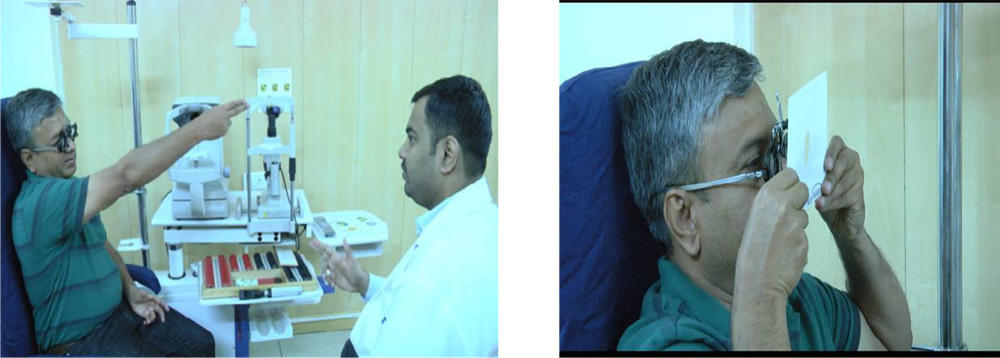
SHOOTING TEST HOLE IN THE CARD TEST
MONOVISION ASSESSMENT
- Dominant eye targeted for emmetropia
- Non dominant eye : myopic by -1.00 to -1.75 D ( depending upon the tolerance)
Check for Suppression and fusion
- All patients had RE dominant, good tolerance to Anisometropia and good suppression and fusion
Spherical Equivalent (SE) change
| RE( Dominant) SE(D) | LE( Non-dominant) SE(D)
|
|
| PRE | -6.14 ± 2.77 | -5.55 ± 2.72 |
| 1 month | -0.25 ± 0.17 | -1.36 ± 0.54 |
| P-VALUE | 0.0 | 0.0 |
Results:1 month
Pre BCVA and Post UCVA
| RE (Dominant) | LE (Non dominant) | |
| PRE- BCVA (LogMAR) | 0.02 ±0.11 | -0.015±0.89 |
| POST-UCVA (LogMAR) | 0.05±0.1 | 0.136±0.89 |
| P-VALUE | 0.17 | 0.00 |
Binocular UDVA
| Post OP UDVA | No of Pt | Percentage |
| >6/6 | 5 | 27.7% |
| 6/6 | 10 | 55.5% |
| 6/7.5-6/9 | 3 | 16.6% |
Fine Stereopsis( deg/arc)
(1000 — Fly Stereopsis Test with LEA Symbols)
| Pre
Corrected |
Post
Un Corrected |
Post
Corrected |
| 141.2 ± 113.5 | 139 ± 122.49 | 97.9 ± 68.8 |
| P= 0.72 | P= 0.05 | |
SALZBERG READING DESK (SRD)
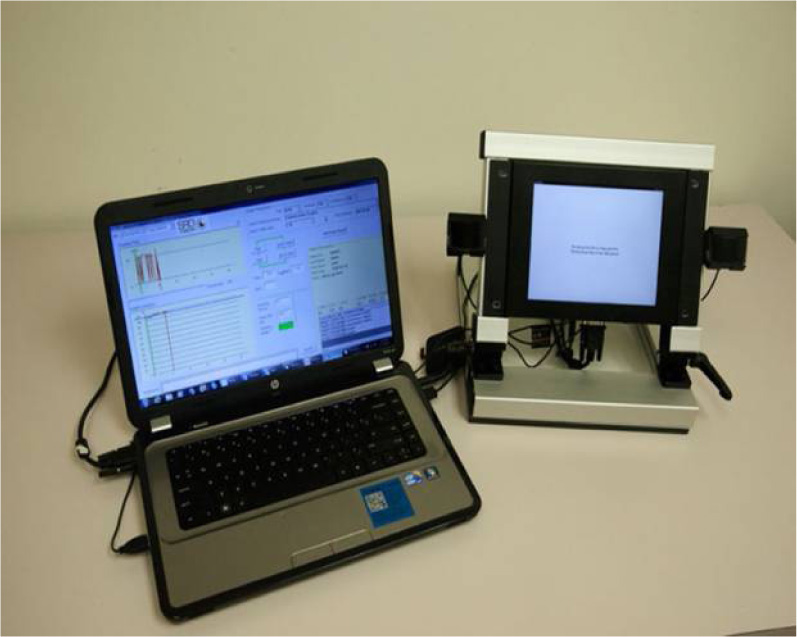
Tool for systematical evaluation of reading acuity and reading speed under standardized conditions. Better evaluation of everyday reading abilities through simulation of natural reading process.
Patient performing SRD
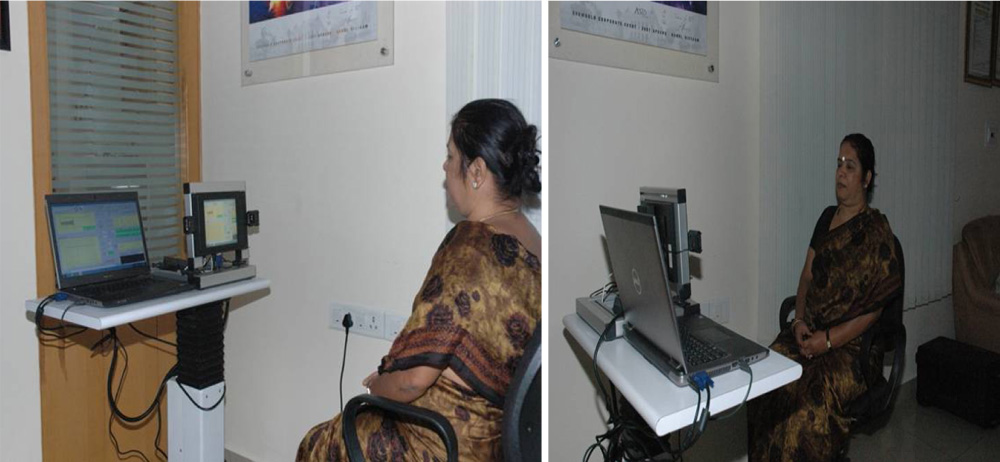
Reading speed (WPM at 40,60 & 80 cm)
| Pre
Corrected |
Post UC | P-value | Post
Corrected |
P-value | |
| 40 cm | 115±26.0 | 108±25.7 | 0.23 | 107±15.9 | 0.33 |
| 60 cm | 126.7±25.0 | 117.8±28.7 | 0.19 | 102.2±14.8 | 0.52 |
| 80 cm | 110.5±24.5 | 122.8±31.4 | 0.08 | 114.1±19.4 | 0.50 |
- No significant difference between UC and Corrected post op reading speeds compared to pre reading speeds
Defocus Curve: Depth of field about 1.5-2 D
(Binocular uncorrected)
SUBJECTIVE Questionnaire (1 month)
- Happy with distance vision: 16/18
- Happy with near vision: 17/18
- Happy with intermediate vision: 18/18
- Halos/ glare( at night) – mild: 4/18
- Headache/ nausea/diplopia: None
- No patient prescribed glasses
CONCLUSION
- Monovision with SMILE may be a valid option to manage presbyopia along with myopic refractive error
- May work better compared to LASIK Monovision:
- Better control of aberrations in SMILE
- Corneal Treatment Profile: More natural prolate
- Use of comparatively larger optical zones
- No fluence projection errors
- Less post-op dry eye
- Auto centration on visual axis
- Initial experience(1 month)- excellent visual outcomes for distance, intermediate and near
- No loss of stereopsis
- Mild reduction in contrast
- Minimal side effects of night-time halos and glare
- Expected to improve over time with neuroadaptation
- Longer follow-ups required to establish the benefits over other laser based presbyopia treating modalities.
Leave a Comment