

Dr. Prakash Chipade, C14867, Dr. Seema Bhosale, Dr. Vijay Shetty, Dr.Suhas Haldipurkar
Introduction
Cataract surgeons are always striving for better accuracy when it comes to the selection of IOL power prior to cataract surgery.
This study represents a comparison of recently introduced intraocular lens power calculation formulas.
Hill RBF
It is a new method for IOL power calculation based on artificial intelligence and pattern recognition.(Radial basis function approach This mathematical method uses artificial intelligence and pattern recognition to select an IOL for a patient.
it has been optimized for use with the HaagStreit LENSTAR, using optical biometry
Hill RBF
Radial basis function algorithms are used throughout the world in a wide range of technologies as diverse as facial recognition software, thumbprint security scanners, automobile engine calibration methods, electrocardiogram interpretation and financial forward forecasting software for the stock market.
Barrett Universal 2 formula
It uses a theoretical model eye in which anterior chamber depth (ACD) is related to axial length (AL) and keratometry. A relationship between the A-constant and a
“lens factor” is also used to determine ACD.
Aim of study
To assess the accuracy of Hill RBF,Barrett,SRK T,Hoffer Q, and Holladay formulae in normal,long and short eyes.
Methods
Method – Secondary data analysis
Site –Tertiary eye care (Laxmi eye institute,panvel)
Duration-Jan 2017 to June 2017
Sample size -153 eyes of who undergone uneventful phaco cataract surgery with PCIOL in the bag implantation were taken
Inclusion criteria
Patients undergone uneventful cataract surgery and biometry performed by Lenstar 900.
Post operative BCVA >6/12
2.8mm clear corneal incision located temporally
Exclusion criteria
Previous intraocular surgery other than cataract.
Pre existing ocular diseases that may influence the post operative refraction, including corneal scarring, endothelial dystrophy, Retinal detachment.
SRK-T, Holladay 1,Barretts universal 2,Hill RBF,Hoffer Q,formulas were calculated using Lenstar 900 .
The predicted IOL power for each formula was taken as target refraction of 0 or first myopic reading closest to 0.
Methods
The patients AL, anterior chamber depth (ACD) and keratometry (K1& K2), lens thickness, values were retrived from records for calculation of formulas.
The post operative refraction at 2 weeks was noted .
Spherical equivalent was calculated using above refraction (Post op sph + ½ post op cyl)
Ideal IOL power was calculated by using formula 1.5 x Spherical equivalent of post op refractive error and this figure was added to IOL implanted.
Eg: IOL power implanted 15D,
Post op refraction = -2.00D
Ideal IOL power = -2 x 1.5 = -3.00
15 + (-3.00)= 12 D
The refractive prediction error was calculated the difference between the ideal IOL power and predicted IOL power.
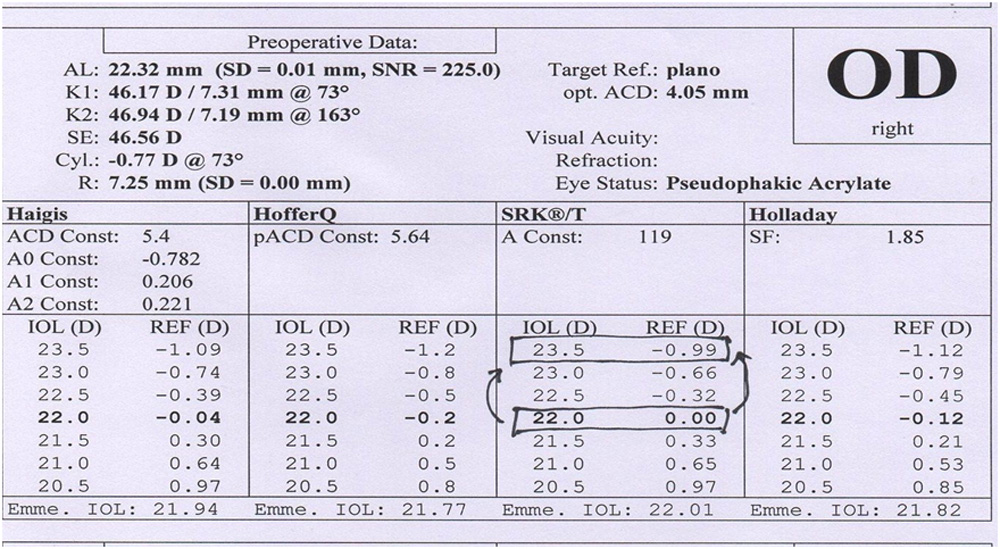
Eyes with an axial length of less than 22 mm were classified as short axial length (SAL); if the axial length was 22–25 mm, the eyes were classified as medium axial length (MAL); and if axial length was greater than 25 mm, the eyes were classified as having a long axial length
(Relation between axial length of the eye and hypotensive effect of latanoprost in primary open angle glaucoma Arranz-Marquez, M A Teus BJO May 2004 – Volume 88 – 5 )
Methods
153 eyes of 132 patients Age 16-84 yrs
Mean age : 61.83 (SD- 10.278)
Out of 153
RE 81(52.9%)
LE 72(47.1%)
Sample distribution
Short eyes (<22mm AL) – 21(13.7%)
Median/ Normal eyes (22-25mm AL) – 109 (71.2%) Long eyes (>25mm) – 23(15%).
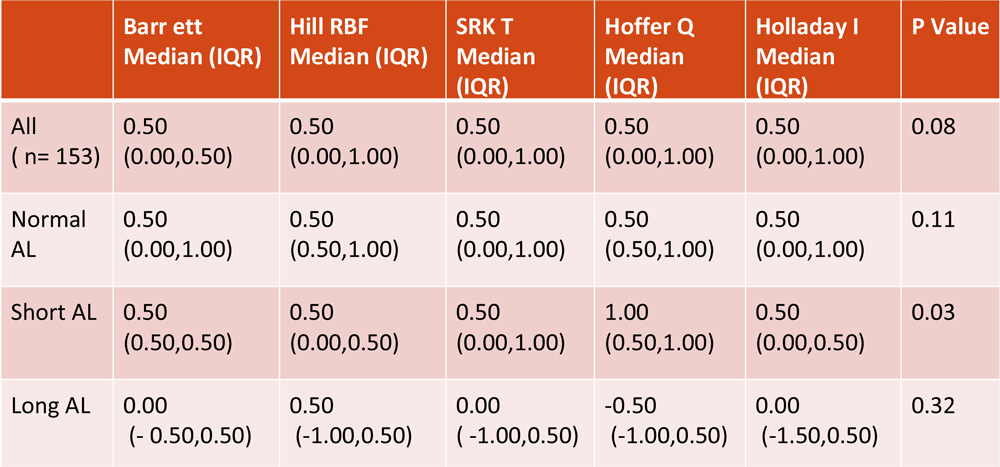
Difference in Median error of iol calculation was statistically analysed by Kruskal Wallis method on STATA software
Box plot showing median error of IOL power with SRK-T,
Holladay 1 and Barrett 2 ,Hill RBF,Hoffer Q, formula across all eyes
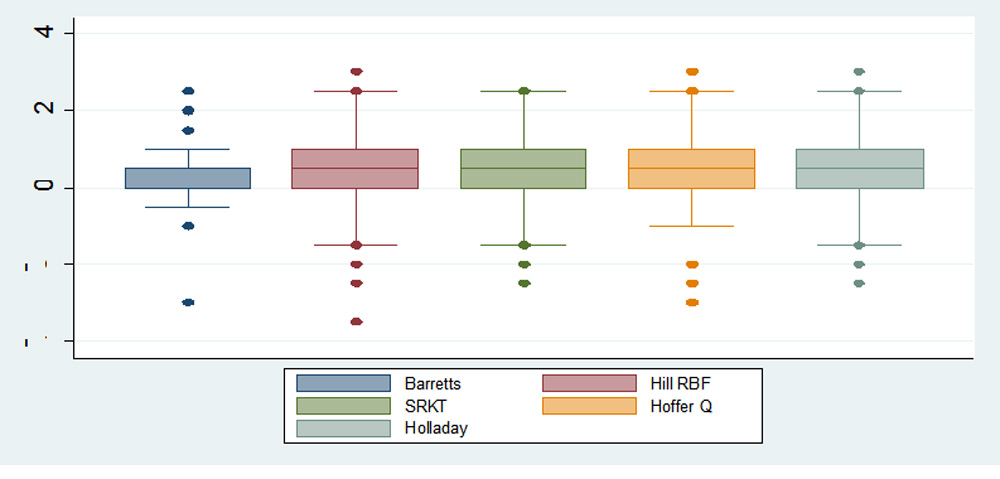
P 0.08
Box plot showing median error of IOL power with SRK-T,
Holladay 1 and Barrett 2 ,Hill RBF,Hoffer Q, formula in normal eyes (AL 22-25)
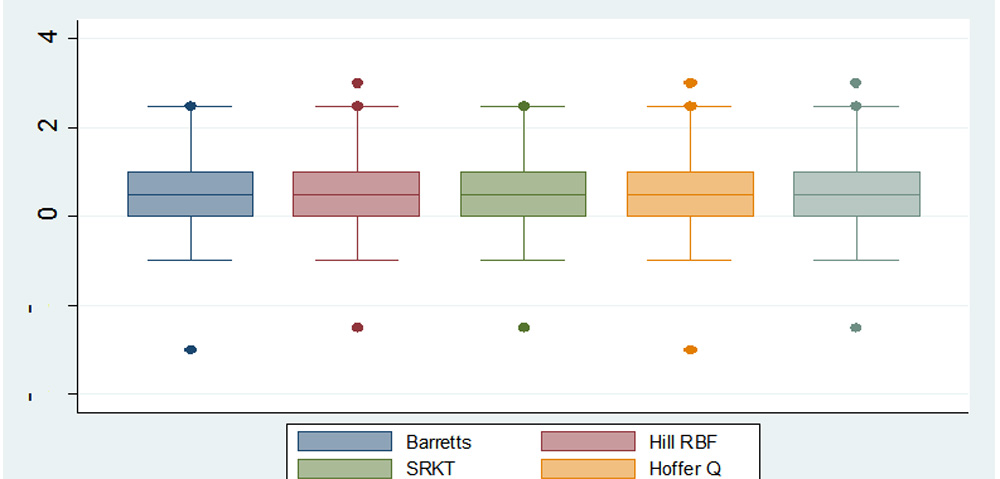
P 0.11
Box plot showing median error of IOL power with SRK-T,
Holladay 1 and Barrett 2 ,Hill RBF,Hoffer Q, formula in short eyes (AL <22).
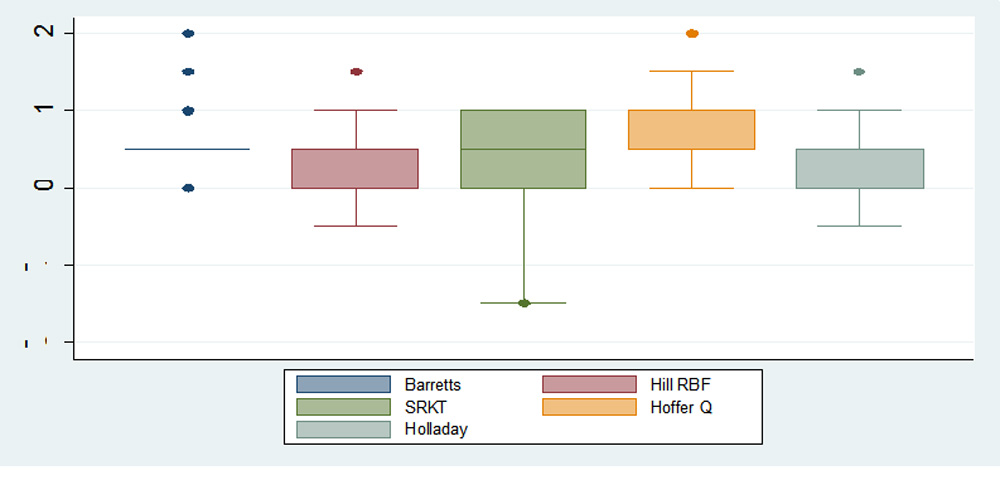
P 0.03 significant
Box plot showing median error of IOL power with SRK-T,
Holladay 1 and Barrett 2 ,Hill RBF,Hoffer Q, formula in long eyes (AL>25)
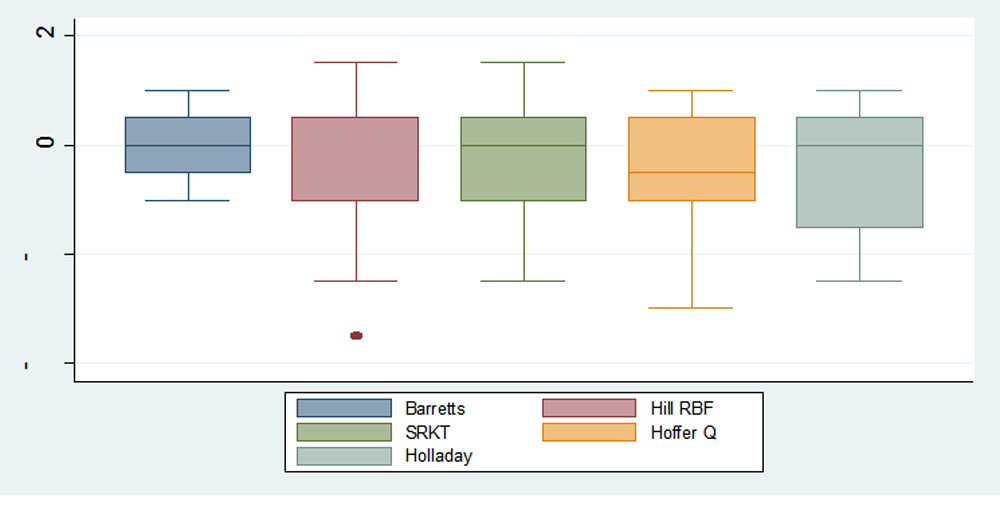
P 0.32
Median Error
Conclusion
In normal eyes all formulae are performing good
In short eyes Barrett is slightly doing better than others
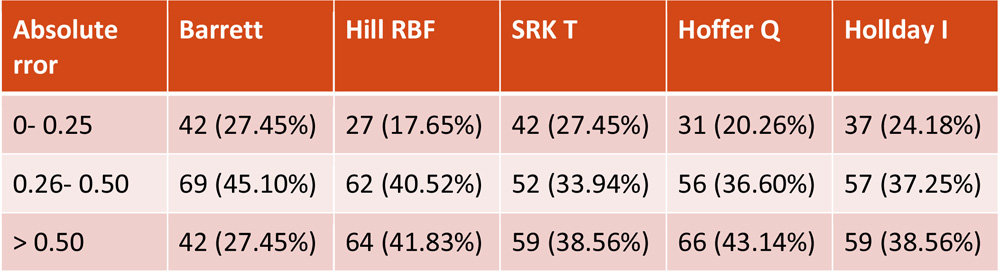
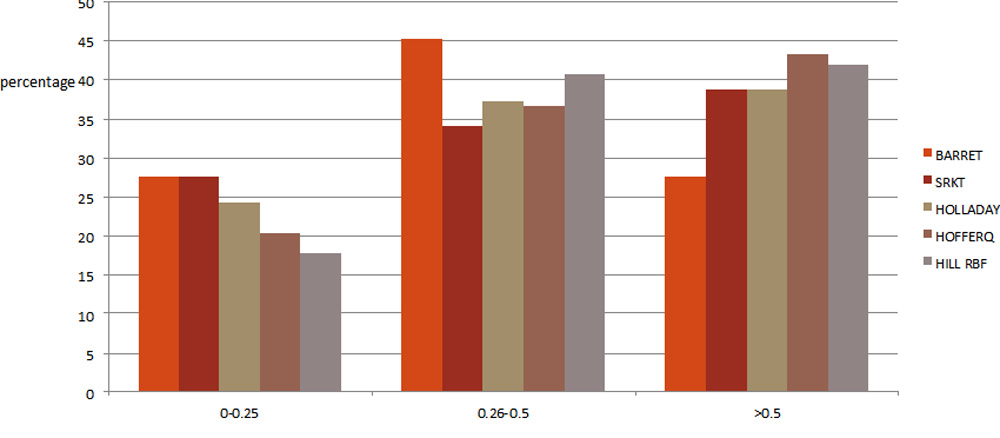
Across all eyes Barrett has least mean value less 0.5D followed by SRK T, then Holladay I then Hill RBF followed by Hoffer Q
Limitation
Small sample size
Retrospective study
Leave a Comment