

Dr. Prachi Agashe, A14607, Dr. Ashish Doshi
Introduction-
Dissociated vertical deviation(DVD) is a characteristic motility finding associated with early onset strabismus and comprises of an upward, outward and torsional movement of the non fixing eye. It is estimated that 40% of the patients with DVD may have some oblique overaction.1
The triad of `A` pattern exotropia with bilateral superior oblique overaction with DVD was first described by Dr. Eugene Helveston in 1969 and is also called the `Helveston Syndrome`. [2]There is sparse literature regarding the surgical management of this strabismus complex.3-7Thehypertropia caused by the DVD and the associated superior oblique overaction pose a real challenge to the management of this condition.
The popular techniques of management include only bilateral superior rectus (SR) recessions; or bilateral SR recession with superior oblique(SO) weakening.Bilateral SR recessions tend to be successful in management of small A pattern with DVD.5Bilateral SR recessions with superior oblique weakening tend to be effective in incomitant DVD with DVD being greatest in abduction, as well as moderate `A` pattern ranging from 12 to 20 PD.3-5 Simultaneous weakening of the SO and SR may convert the existing `A` pattern into a V pattern by inversion of vertical incomitance. Also, when the exotropia tends to be large or in cases of reoperations, there is a risk of anterior segment ischemiawhen the superior rectus needs to be operated along with the horizontal recti.
Gamioet al used the four oblique weakening procedure for A pattern with DVD in 9 patients based on the new proposed etiology of the cyclovertical muscles being responsible for DVD.7 Velez et al have shown good outcomes of the this procedure in their series of 14 patients.5 We report the results of this procedure in six patients at a mean follow up of two years.
Materials and Methods-
We conducted a retrospective review of six consecutive patients presenting with Helveston syndrome all of whom underwent surgery for their strabismus complex. Patients with deep unilateral amblyopia, previous oblique muscle surgery or vertical muscle surgery and follow up less than 12 months were excluded from the study. All the patients underwent horizontal muscle surgery depending on the amount of exotropia along with superior oblique tenectomy combined with inferior oblique anteropositioning(total, pure or subtotal?). (Table 1)
Every patient underwent visual acuity recording, cycloplegic refraction, anterior segment examination and fundus evaluation. An orthoptic work up comprised of recording of binocular single vision, stereopsis and alternate cover test. Prism cover test was done for near as well as distance and also for upgaze, downgaze and lateral gazes. Based on this the amount of `A` pattern was measured in prism dioptres.DVD was measured using the prism under cover test where base down prisms were placed under cover to neutralise the hyper movement which was done on either eye. The amount of DVD was measured in primary position. Superior oblique overaction was graded on a 9-point scale graded from -4 to +4.8The patients were followed up on day 1, day 10 and after 1 month and thereafter 4 monthly as deemed necessary by the examining ophthalmologist. The measurements obtained at the last follow up were used to compare the results with the preoperative measurements.(Fig 1 and Fig 2)
A small write up of surgical technique wouldbe apt
Results-
The mean age of the cohort was 12.5 +/-7.6 years.The mean postoperative follow up was 2.1 +/-1.1 years. The mean reduction in exotropia was from 36.5+/- 21.06 prism dioptres(PD) to 6.1+/-3.06PD. The procedure corrected the A pattern from a mean 23 +/-7 to 7.6+/- 3.2 PD. The average DVD in the right eye was 14 +/- 4.3 PD and in the left eye was 14.33+/-3.6PD and the mean asymmetry was 6.33+/-3.4 PD. DVD was considered to be asymmetric when the difference between the two eyes was greater than 7PD. In two patients the difference between the two eyes was 10 PD. They also underwent the same surgical procedure with good outcomes and no residual hypertropia. Post operatively the average DVD in the right eye was 5.3+/-1.2 PD and that in the left eye was 4.1+/-1.1 PD while the mean reduction in asymmetry of DVD was from 6 +/-3 to 1.5 +/- 1.3 prism dioptres. (Table 2).None of the patients developed fusion or stereopsis post operatively.
Discussion-
The presence of A pattern strabismus with DVD is a complex strabismus where good results can be obtained by choosing the right surgical plan.The popular choice for management would be SR recession with SO tenectomy. Small to moderate `A` patterns measuring less than 20 PD may respond well to superior rectus weakening with superior oblique weakening. 3,5However,this procedure is also fraught with the risk of inversion of pattern. Melek et al in his series of three patients reported correction of `A ` pattern from 39 to 15 PD. 9 However, all patients had an inversion to a `V` pattern measuring 5- 12 PD. When this complex is associated with a large angle exotropia the eyes are prone to the risk of anterior segment ischemia if a horizontal recess resect procedure has to be chosen along with superior rectus recession. In our series two patients had an exotropia measuring more than 50 PD. In our cohort two patients had an `A ` pattern less then 20PD while the other four patients had a large `A` pattern more than 20 PD. Four oblique weakening procedure showed the greatest impact in collapsing the pattern as well as the correction of DVD. Velez et al reported that the `A` pattern collapsed from 31.8+/- 5.5 PD to 1.7+/-2.4 PD at a follow up of one year while in our series `A` pattern collapsed from 23+/-7 PD to 7+/- 3 PD using the four oblique weakening procedure at a mean follow up of two years. They reported average DVD reduction from 13.3+/- 2.4PD to 3.9+/-2.5 PD and reduction in DVD asymmetry from 4.6+/-4.6PD to 3.7+/4.2PD.5 In our series DVD reduced at an average of 14 +/- 4.3 PD in the right eye to 5.3 /-1.2 PD postoperatively and in the left eye from 14.33 +
/-3.6 PD to 6.3+/-3.4 PD while the DVD asymmetry dropped from 6+/- 3 PD to 1.5+/- 1.3 PD at an average follow up of two years.
The exact elucidation of the efficacy of the fouroblique weakening procedure is not very clear. Guyton et al had studied six patientsof DVD using scleral search coils. (reference) He suggested that a vertical vergence movement occurred with the fixing eye tending to intort and depress and the covered eye extorting and elevating. Enright et al in 1992 (reference)had also suggested a disparity induced vertical vergence in humans associated with binocular torsion and concluded that the oblique muscles in both eyes are largely responsible for vertical vergence movements induced by small vertical disparities. The determination of the vertical movement being produced by an oblique muscle or vertical muscle was decided by detection of the torsional movement that occurred simultaneously with the vertical movement.Guyton suggested that a normal oblique muscle produced cycloversion/vertical vergence in an exaggerated form probably as a learned response which helps in improving vision in the fixing eye.
Gamio et al published his results of four oblique weakening procedure on 9 patients of DVD to reduce bilateral cyclotorsion. Of these, 5 patients had A pattern with SOOA and A pattern decreased from 19.4+/- 8.8PD to 3+/-3.7PD. We obtained an A pattern correction from 23+/- 7 PD to 7+/-3PD. All patients in their group had symmetrical DVD which reduced in the right eye from 17.9 PD+/-6.3PD to 6.4+/- 4.4 PD and in the left eye from 17.7+/- 6.1 PD to 5.7+/-3PD. We obtained an average DVD reduction from 14 PD to 6 PD in the right eye and 14.3PD to 6.3PD in the left eye.
This study has its limitations of being a retrospective review of a small sample size with no control group. Our study did not consider the incomitance of DVD over the horizontal gaze. It could be possible that SR recessions would have given good results in patients with DVD with incomitance over the horizontal gaze. However, we obtained good results with respect to control of DVD in the primary position with collapsing of the `A` pattern.
Conclusion-
Four oblique weakening procedure with horizontal muscle surgery seems to be an effective method for significantly correcting the A pattern exotropia as well as reducing the amount of DVD with good long term outcome in our case series. It is definitely indicated in patients with a large A pattern and in patients with risk of anterior segment ischemia as well as to reduce the chances of inversion of the pattern.
Table 1
| Case 1 | Case 2 | Case 3 | Case 4 | Case 5 | Case 6 | |
| Age (years) | 26 | 8 | 8 | 12 | 16 | 5 |
| Vision OD
OS |
6/9 | 6/24 | 6/12 | 6/18 | 6/12 | 6/9 |
| 6/18 | 6/9 | 6/9 | 6/18 | 6/12 | 6/9 | |
| Horizontal deviation | 15 PD XT | 57 PD XT | 40 PD XT | 65 PD XT | 17 PD XT | 25 PD XT |
| A pattern | 18 PD | 25 PD | 15 PD | 25 PD | 20 PD | 35 PD |
| DVD OD
OS |
18 PD | 12 PD | 14 PD | 12 PD | 20 PD | 8 PD |
| 10 PD | 14 PD | 18 PD | 16 PD | 10 PD | 18 PD | |
| Surgical procedure | BE LR recess 3.5mm, BE PTSO, BE IOAT | RE 8mm LR recess with 6 mm MR resect, BE PTSO, BE IOAT | BE LR recess 8.5mm, BE PTSO, BE IOAT | RE 8 mm LR recess with 5.5 mm MR resect with LE LR recess 5.5mm, BE PTSO, BE IOAT | BE LR recess 4 mm, BE PTSO, BE IOAT | BE LR recess 5.5 mm, BE PTSO, BE IOAT |
| DVD- Dissociated vertical deviation, PD- Prism dioptres, XT- ExotropiaLR- Lateral rectus, MR- Medial rectus, RE- Right eye, LE- Left eye, BE- Both eyes, PTSO- Posterior tenectomy of the superior oblique, IOAT- Inferior Oblique Anteropositioning | ||||||
Table 2
| Sr. No | Preoperative | Post operative |
| Average XT | 36.5+/-21.6 PD | 6.1+/-3.06 PD |
| A pattern | 23+/-7 PD | 7.6+/-3.2 PD |
| DVD RE | 14+/-4.3 PD | 5.3+/-1.2 PD |
| DVD LE | 14.3+/-3.6 PD | 4.1+/-1.1 PD |
| DVD Asymmetry | 6.33+/-3.4 PD | 1.5+/-1.3 PD |
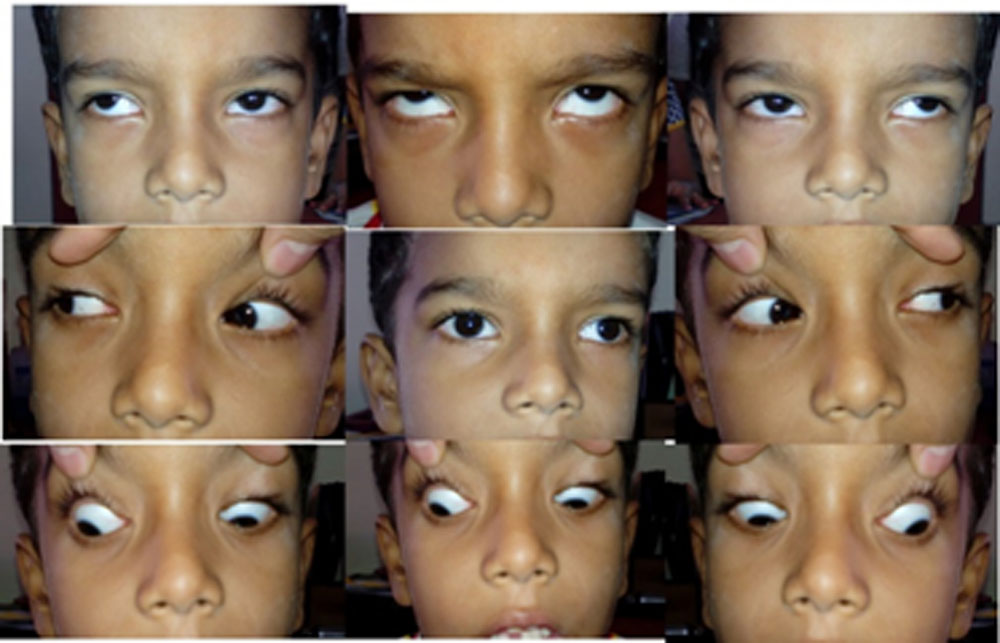
Fig 1- Pre operative photograph
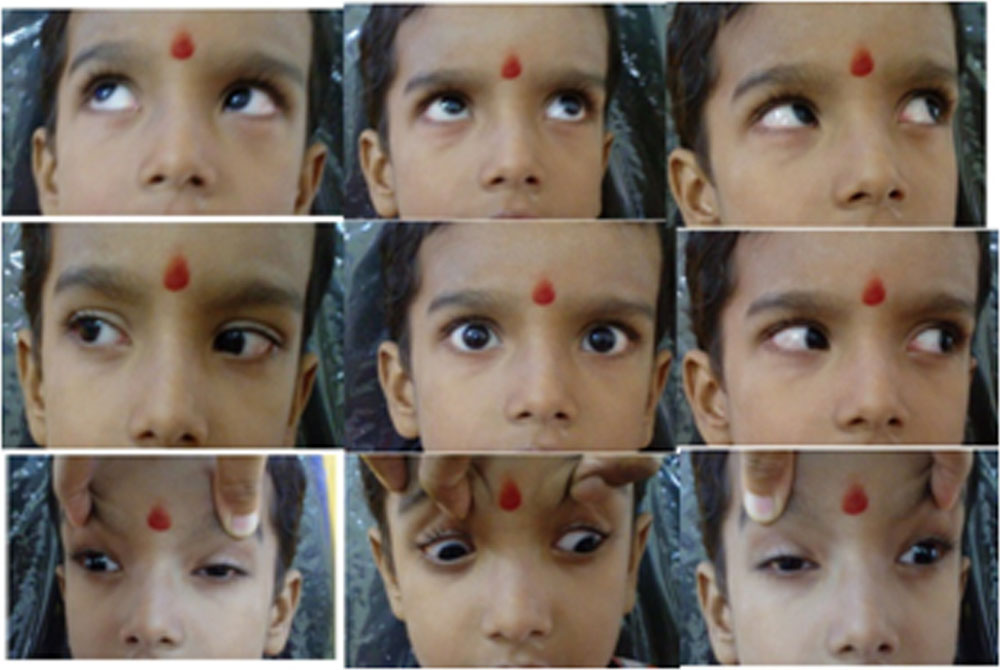
Fig 2- Post operative photograph
References-
- Helveston Dissociated Vertical Deviation- a clinical and laboratory study. Trans Am Ophthalmol Soc. 1980;78:734-79
- Helveston A- exotropia, Alternating sursumduction, and superior oblique overaction. Am J Ophthalmol. 1969Mar;67(3):377-80
- Suma Ganesh, Nidhi Khurana, SumitaSethi, Priyanka Arora Simultaneous surgical correction of dissociated vertical deviation, superior oblique overaction and A-pattern with associated horizontal strabismus: A case series .Oman J Ophthalmol. 2013 Jan-Apr; 6(1): 66–68
- McCall LC, Rosenbaum AL. Incomitant Dissociated Vertical Deviation and Superior Oblique overaction.Ophthalmology. 1991 Jun;98(6):911-7
- Velez FG, Ela-Dalman N, Velez G Surgical Management of dissociated vertical deviation wit A pattern strabismus J AAPOS. 2009 Feb;13(1):31-5
- Ha SG, Suh YW, Kim SH Clinical Features and Surgical outcome of Triad Exotropia J PediatrOphthalmol Strabismus. 2017 Jul 5:1-6
- Gamio S. A surgical alternative for dissociatedvertical deviation based on new pathologic concepts: weakening all four oblique eye muscles. Outcome and results in 9 cases.Binocul Vis Strabismus Q. 2002;17(1):15-24
- Scott WE, Kraft SP. Classification and surgical treatment of superior oblique palsies: I. Unilateral superior palsies. In: Pediatric Ophthalmology and Strabismus: Transactions of the New Orleans Academy of Ophthalmology. New York: Raven Press, 1986; 15-38.
- Melek NB, Mendeza T, Ciancia AO Bilateral recessions of superior rectus muscles: Its influence on A and V pattern s J AAPOS.1998 Dec;2(6):333-5
Leave a Comment