

Dr. Nikita Dash, N20254, Dr. Sumita Mohapatra,
Dr. Bijay Kumar Pattnaik, Dr. Samerendra Mohapatra
Introduction
Dry eye disease (DED) is one of the most frequently encountered ocular morbidities. About 25% of patients who come for eye check-up report with dry eye symptoms, making it a growing public health problem and one of the most common conditions seen by ophthalmologists. Although, dry eye disease has usually been considered a disease of the elderly and of post-menopausal women, recently there has been a rise in patients presenting with dry eye symptoms in the paediatric age group. Though, usually this condition in children is either overlooked or attributed to other causes of ocular irritation (allergies), recent studies have claimed an association of, paediatric dry eye disease with the usage of video display terminal units.
Recent surveys have shown quite an increase in the use of smartphones and tablets in India. The average age for a child getting their first smartphone is now 10.3 years. Use of these smartphones and/or other video display terminals (laptops, desktops, tablets, television) for long hours has been associated with a decreased maximum blink interval, hence development of dry eye symptoms. In addition, many people report ocular fatigue after prolonged work with video display terminals.
Paediatric DED is a growing concern for ophthalmologists all over, and its importance should not be undermined. Therefore this study was conducted as an attempt to establish any validity in the development of DED due to smartphone usage.
Aim
The objective is to study relationship between smartphone usage and the development of dry eye disease in the paediatric age group.
Materials and Methods
It is a prospective, observational study including 78 patients, urban-44(56.4%), rural-34(43.6%), in the age group 5-15 years, attending RIO, S.C.B.Medical College, Cuttack during July 2016 to March 2017. After a thorough history was taken, the signs and symptoms were evaluated and the patients were subjected to questionnaires. Questionnaires were designed to obtain information regarding mean daily duration of video display terminal (smartphone, tablets, computer, television, and laptop) use, learning (reading and writing), outdoor activities, and past history of allergic disease and anti-histamine drug use.
The symptoms were evaluated on the basis of the Ocular Surface Disease Index (OSDI) score, where patients were asked a series of 12 questions, according to the answers the score was obtained on a scale of 0-100 and patients were accordingly graded into normal, mild, moderate and severe dry eye disease. The patients were evaluated at presentation for fluorescein corneal staining, tear film break-up time (TBUT), Schirmer’s test (ST), and inter-blink interval (IBI). After cessation of smartphone (SP) use for 1 month, the parameters were evaluated and compared again.
For ease of comparison and to better elicit the relationship between dry eye disease and smartphone use , the patients were divided into two categories : Category A, for those using SP continuously for more than or equal to half-hour at any given time , and Category B, for those using SP for less than half-hour at any given point of time.
Inclusion criteria
- Patients diagnosed with DED between 5-15 years of age.
Exclusion criteria
- Children who underwent any type of eye surgery in the past six months.
- Children who had nocturnal lagophthalmos.
- Children who had eyelid problems like trachoma, trichiasis, distichiasis or epiblepharon.
- Children who had allergic conjunctivitis with the use of antihistaminic drugs.
- Contact lens wearers.
- Children who had any congenital, endocrine or auto-immune disease.
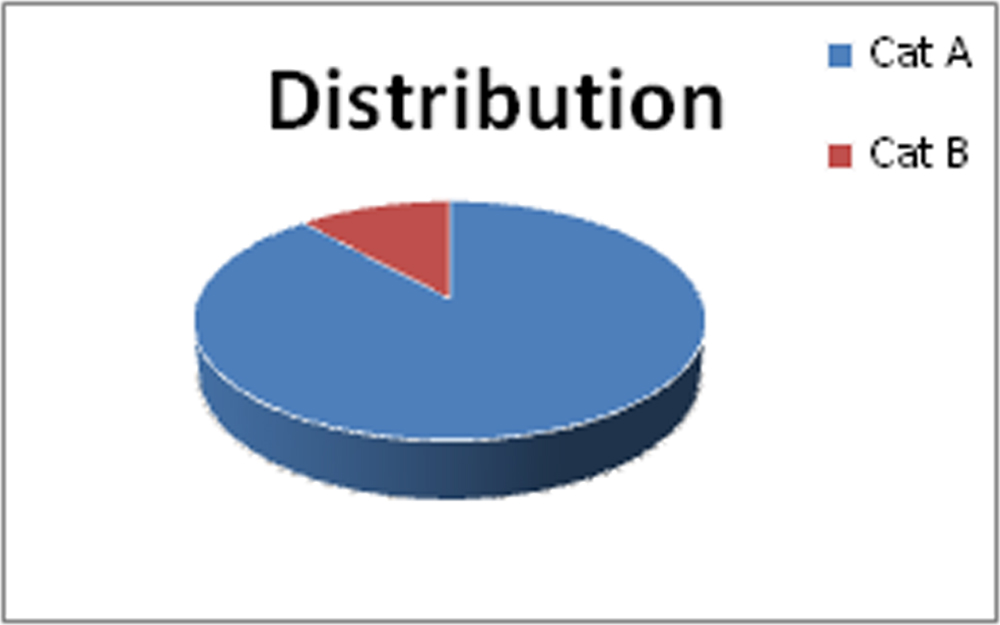
Results: Of the 78 patients , 88.4% belonged to category-A whereas 11.6% belonged to category-B.
The median age of patients in category-A was 11.5+/-1.6 years and that of patients in category B was 13.5+/-0.8years
| Males | Females | |
| Cat-A | 54 | 15 |
| Cat-B | 7 | 2 |
Demographic Profile:
| Urban | Rural | |
| Cat-A | 43 | 26 |
| Cat-B | 1 | 8 |
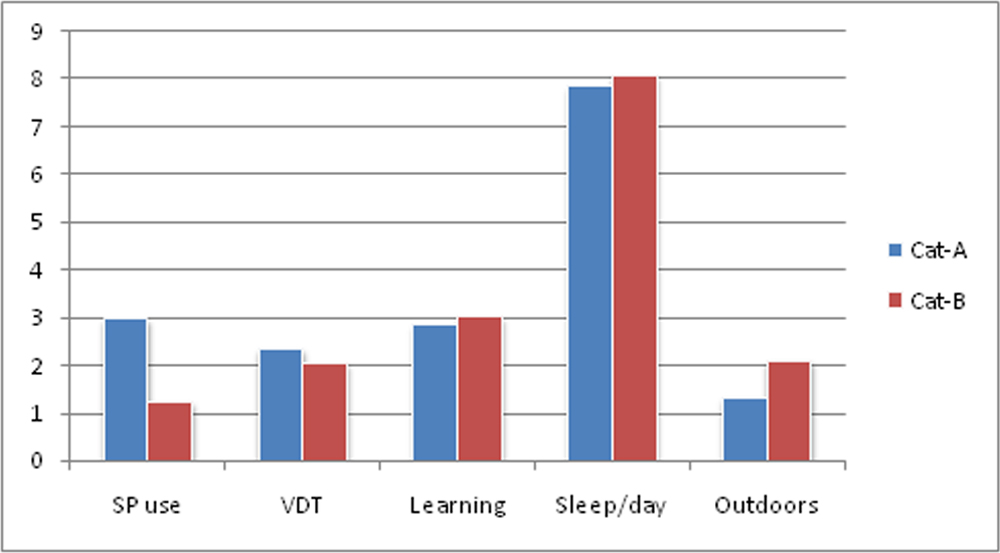
Mean duration of activities in both groups in hours is given as follows:
Comparison of results after cessation of smartphone use in parameters examined in category-A:
| Before cessation | After cessation | % showing improvement | % showing no change | % showing worsening | |
| Mean TBUT | 8.87 | 10.26 | 92.1 | 7.9% | —- |
| Mean IBI | 2.89 | 4.58 | 92.1 | 7.9% | —- |
| Mean Schirmer’s Test value | 8.7 | 13.3 | 90.9% | 9.1% | —- |
| No. of Fluorescein +ve cases | 23 | 5 | 78.26% | 21.74% | —– |
Comparison of results after cessation of smartphone use in parameters examined in category-B:
| Before cessation | After cessation | % showing improvement | % showing no change | % showing worsening | |
| Mean TBUT | 9.45 | 11.28 | 77.8% | 22.2% | —– |
| Mean IBI | 4.32 | 5.34 | 88.9% | 11.1% | —— |
| Mean Schirmer’s test value | 9.5 | 15.5 | 77.8% | 22.2% | —— |
| No. of fluorescein +ve cases | none | none | —– | —– | —— |
Change in mean OSDI scores in both categories:
| Category-A | Category-B | ||
| Before | 36.76 | 31.45 | |
| After | 16.63 | 12.53 | |
| % change | 54.7% | 60.2% | |
Discussion:
Of the 78 patients (urban-44, rural-34), 88.4% belonged to category-A whereas 11.6% belonged to category-B. Overall males were more affected with category-A having a male: female ratio at 18:5 and that of category-B at 7:2. The number of urban users were more in Category-A (43,62.3%) whereas in category-B the number of rural users were higher (8, 88.9%). Mean TBUT was recorded at 8.87s in category-A that later improved to 10.26s in 92.1% of subjects. Those in category-B recorded a higher mean TBUT at 9.45s at baseline, which further improved to 11.28s on cessation with 77.8% showing improvement. Mean IBI at baseline for category-A was recorded at 2.89s which improved to 4.58s, with 92.1% subjects showing improvement. Mean IBI was recorded at 4.32s at baseline in category-B; later improved to 5.34s with 88.9% reporting improvement. Similarly values in ST also showed improvements in both categories. Fluorescein staining was reported in Category-A mostly, 78.26% of which showed no staining after cessation of smart phone use for a month.
The OSDI scores also showed significant results in favour of smartphone cessation. There was 54.7% decrease in mean OSDI score in category-A and 60.2% decrease in mean OSDI score in category-B.
Conclusion:
Increased use of smartphones is a serious issue that can result in ocular surface symptoms, especially in paediatric age group. Although the continuous use is found to be more detrimental than intermittent use or judicious use with enough breaks to avoid ocular fatigue. Therefore, close observation and caution should be practised when allowing children to use smartphones.
References:
- Moon JH, Kim KW, Moon NJ. Smartphone use is a risk factor for pediatric dry eye disease according to region and age: a case control study. BMC Ophthalmol 2016 https://bmcophthalmol.biomedcentral.com/articles/10.1186/s12886-016-0364-4
- McCarty CA, Bansal AK, Livingston PM, Stanislavsky YL, Taylor HR. The epidemiology of dry eye in Melbourne, Australia. Ophthalmology. 1998;105:1114-9.
- Ang CK, Mohidin N, Chung KM. Effects of wink glass on blink rate, nibut and ocular surface symptoms during visual display unit use. Curr Eye Res. 2014;39:879–84.View ArticlePubMedGoogle Scholar
- Yaginuma Y, Yamada H, Nagai H. Study of the relationship between lacrimation and blink in VDT work. Ergonomics. 1990;33:799–809.View ArticlePubMedGoogle Scholar
- Yang WJ, Yang YN, Cao J, Man ZH, Yuan J, Xiao X, Xing YQ. Risk factors for Dry Eye syndrome: a retrospective case-control study. Optom Vis Sci. 2015;92:199–205.View ArticleGoogle Scholar
- González-Pérez M, Susi R, Antona B, Barrio A, González E. The Computer-Vision Symptom Scale (CVSS17): development and initial validation. Invest Ophthalmol Vis Sci. 2014;55:4504–11.View ArticlePubMedGoogle Scholar
- Alves M, Dias AC, Rocha EM. Dry eye in childhood: epidemiological and clinical aspects. Ocul Surf. 2008;6:44–51.View ArticlePubMedGoogle Scholar
- Moon JH, Lee MY, Moon NJ. Association between video display terminal use and dry eye disease in school children. J Pediatr Ophthalmol Strabismus. 2014;51:87–92.View ArticlePubMedGoogle Scholar
Leave a Comment