

Dr. Sonal Dua, D16060, Dr. Vibha Mehta, Dr. Vaishali Abhaykumar Vasavada, Dr. Mayuri B Khamar
Abstract:
Aim: To determine the long term effectiveness of selective laser Trabeculoplasty (SLT) in Indian eyes with Primary open angle glaucoma(POAG) or Ocular Hypertension(OHT)
Settings and Design: Prospective, nonrandomized, interventional study
Methods and Material:Patients with POAG or OHT were enrolled.108 eyes were studied. In 31 eyes, glaucoma medications were continued at the time of performing SLT. In 77 eyes, glaucoma medications were discontinued till their washout period.SLT was performed using a standard approach treating 360-degrees.Main outcome measures were IOP reduction and number of glaucoma medications used before operation, at 1 day,1month,6 months and 1 year follow-up.
Statistical analysis used: Paired‘t’ test
Results:Mean age of patients was 55+13 years. There were 50.9% females and 49.1% males. Mean IOP dropped from 18.89 + 3.99mmHg pre-treatment to 16.68 + 4.9mmHg at 12 months follow-up, difference being statistically significant (p=0.04). IOP reduction of >15% was found in 69.2% eyes on day 1, 56.6% eyes at 1 month,54% eyes at 6 months and in 35% eyes at 1 year follow-up. Mean number of medications dropped from 1.51+1.17 pre-treatment to 0.56+1.0 at 1 month and 0.85+0.99 at 6 months, reduction being statistically significant(P<0.0001).
Conclusion: SLT is effective in reducing IOP and number of glaucoma medications in Indian eyes with POAG and OHT. However, effect does show a wear off over time.
Keywords: selective laser Trabeculoplasty, primary open angle glaucoma, ocular hypertension, anti-glaucoma medications, intra-ocular pressure
Key Messages:SLT can be used either as ‘primary or secondary line of management’ in pigmented Indian eyes with POAG or OHT.
Medical therapy is the mainstay of treatment for primary open angle glaucoma. However, there are number of concerns regarding chronic medical therapy like poor compliance, side effects and wide fluctuations in IOP due to trough effects and worsening the prognosis of glaucoma surgery due to drug induced ocular surface changes. To overcome these problems SLThas come as a novel therapy
Introduction:
SLT stands for ‘Selective Laser Trabeculoplasty’. It is a laser procedure used to lower intraocular pressure in patients with primary open angle glaucoma and ocular hypertension. It is safe & cost-effective treatment modality with no compliance issues. It produces its effect by selective absorption of energy in pigmented trabecular meshwork, sparing the adjacent structures from thermal damage with minimal morphological alteration in the tissues post treatment
Subjects and Methods:A prospective interventional study was performed on 158 eyes that underwent SLT in our outpatient department out of which 55 eyes (47 patients) completed 4 years follow up and were included in this study. The study adhered to the principles of the Declaration of Helsinki. Informed consent was taken from all the patients after explaining the procedure and approval by the institutional review board was obtained prior to the study commencement. The authors declare no financial or conflicting interests.
The cases of Primary Open Angle Glaucoma (POAG) and Ocular Hypertension(OHT) either newly diagnosed or currently on medical therapy were included. Number of anti-glaucoma medications patients were using pre-SLT were recorded. Baseline IOP was measured for each patient using Goldmann Applanation Tonometer and IOP was also recorded before performing the SLT.
All recruited patients received a single session of SLT. To achieve miosis, Pilocarpine 2% eye drop was instilled every 15 minutes for 2 times. Under effect of topical anaesthesia, Latina Gonio lens was placed on eye. Laser was delivered in affected eye with an initial energy of 0.8 mJ (0.6 mJ-1.2 mJ). The power was titrated up or down until bubble formation was just visible. All eyes were treated 360⁰ in Trabecular meshwork using standard approach. Approximately 80-100 shots were delivered to treat each eye. The procedure was performed by single glaucoma specialist in all cases. Both eyes were treated in the same laser session for those with bilateral disease. Post-operative non-steroidal anti-inflammatory eye-drops and anti-glaucoma eye-drops were given for a period of one week.
Post SLT intraocular pressure was measured after 1 hour and then patients were followed up at one day, one week, three months, six months, 1year and then yearly upto 4 years. At each follow up IOP was measured using Goldmann Applanation Tonometer. Diurnal variation of IOP was done every 3 months for each patient and visual fields and optic nerve head OCT were repeated every 1 year.
Results:
Baseline Demographics:
Fifty-five eyes of 47 patients (5 unilateral and 25 bilateral cases) were enrolled. Out of 55 eyes, 48 were males and 7 were females. There were 46 patients with POAG and 9 patients with Ocular hypertension. 9 patients were not on any medication and SLT was done as a primary treatment, 23 patients were on less than 2 anti-glaucoma medications and remaining 23 were on more than 2 medications, out of which 2 patients were on maximum therapy (i.e. 4 drugs). Mean age was 56.71 ± 10.66 years (range 30-76 years). All subjects were Indians with pigmented TM and open angle configuration. Mean (pre-study) baseline IOP with current medication in all patients was 19.06 ± 2.8 mm of Hg.
Table 1.Demographic data
| PARAMETERS | N(%) |
| Total no. of patients (underwent SLT) | 158 |
| No of patients (follow up-4years) | 55 |
| Male | 47 |
| Female | 8 |
| Age (range) | 30-76 |
| Mean age | 56.71 |
| Primary Open Angle Glaucoma | 46 |
| Ocular Hypertension | 9 |
| Bilateral | 25 |
| Unilateral | 5 |
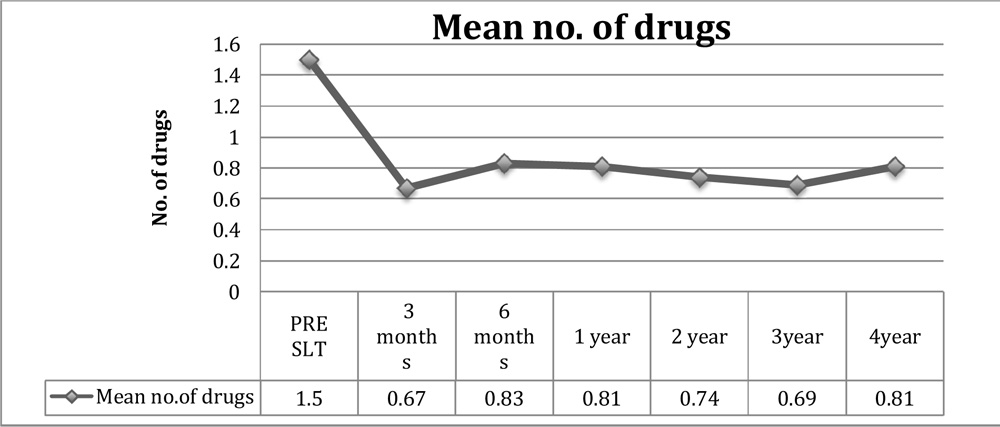
Mean IOP (mmHg) reduced to 15.55 ± 2.43, 16.51 ± 4.44, 16.02 ± 3.21 and 15.78 ± 3.0 at 6 months, 1 year, 2 years and 4 years post SLT. Mean number of drugs reduced from baseline (pre-SLT) 1.50 ± 1.08 to 0.84 ± 1.21, 0.81 ± 1.19, 0.74 ± 1.13, 0.81 ± 1.12 at 6 months, 1 year, 2years and 4years after SLT which is statistically significant(p-value<0.05).
Table 2: Mean IOP before and after SLT
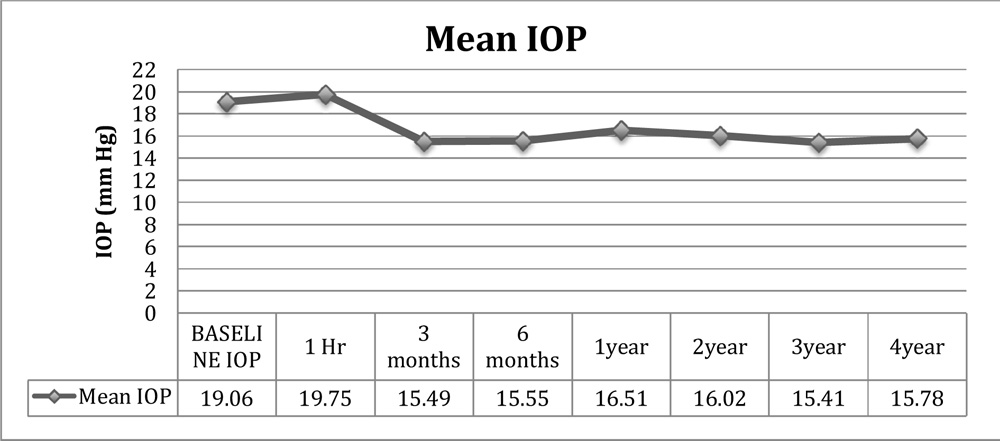
Table 3: Mean reduction in number of medications
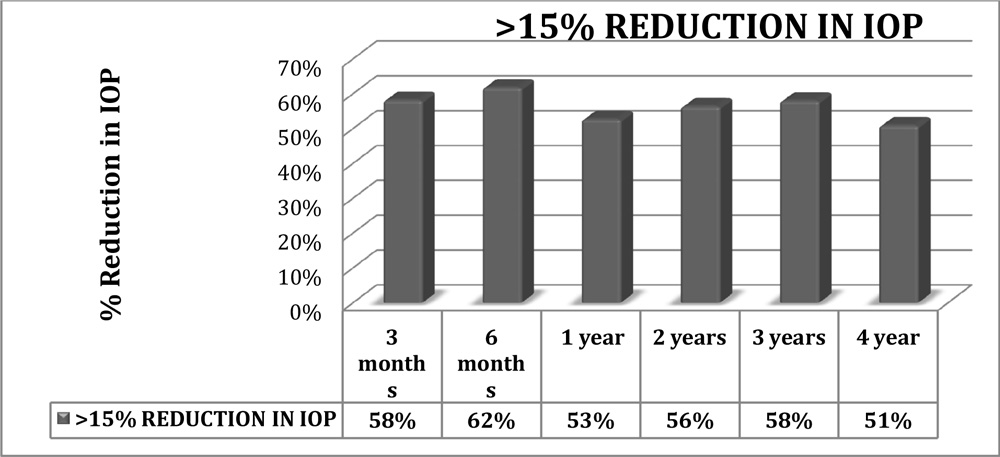
Percentage reduction in IOP of more 15% was seen in 34 eyes (62%) after 6 months, 29 eyes (53%) after 1 year, 31 eyes (56%) after 2 years and 28 eyes (51%) after 4 years of SLT procedure.
Table 4. Percentage of eyes (%)showing >15%Reduction in IOP(mmHg)from baseline
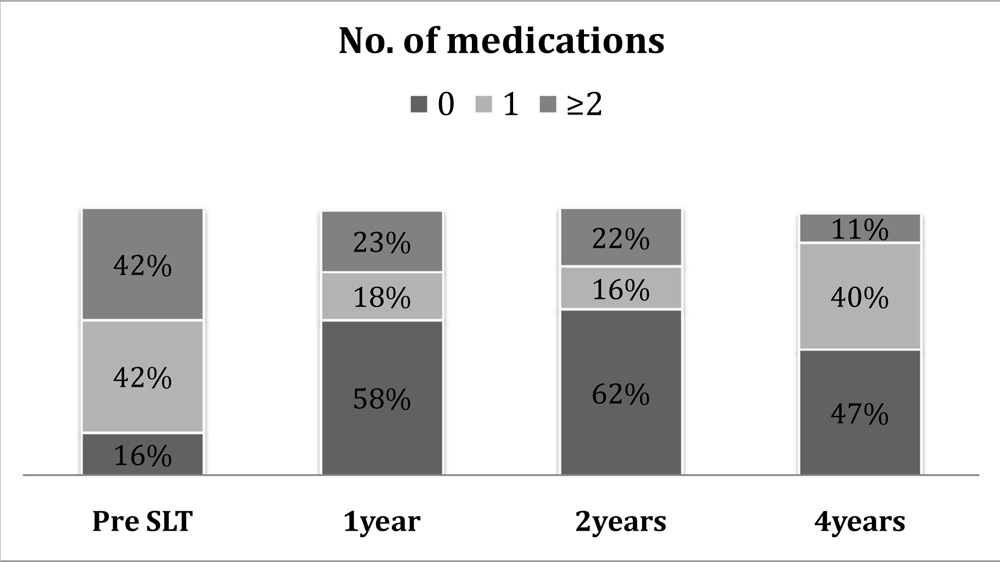
Looking into the drug profile of the patients 58%, 62% and 47% of the patients were not on any medication at 1year, 2years and 4years respectively post-SLT.
Table 5. Drug profile of patients over 4 years
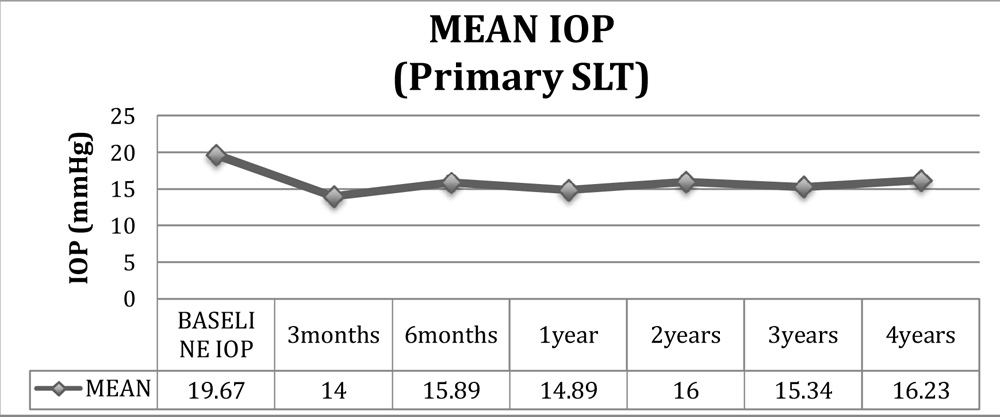
Significant reduction in mean IOP from baseline 19.67mmHg to 16.23mmHg was observed in patients where SLT was done as a primary treatment modality.
Table 6. SLT as a primary treatment in 9 eyes with Ocular Hypertension
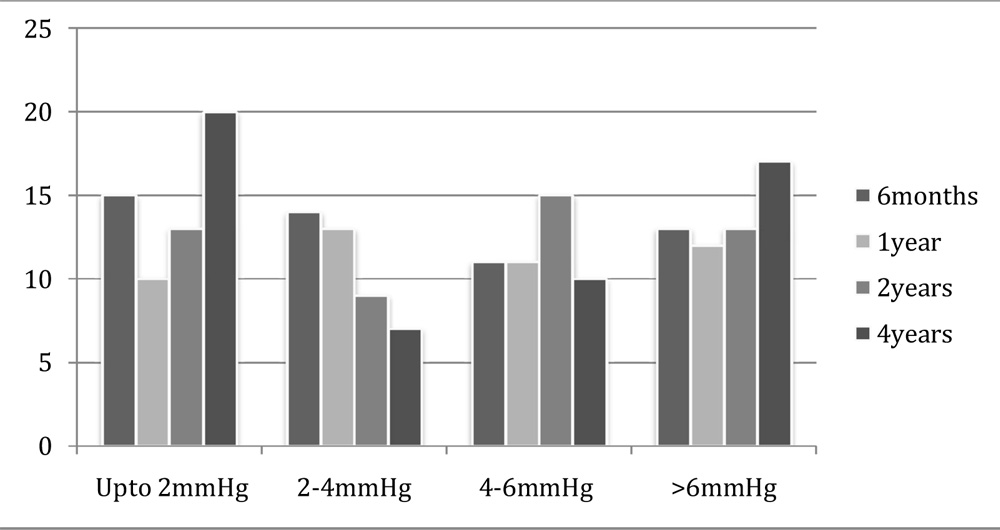
Difference in intraocular pressure of more than 6mm of Hg post SLT was observed in 12eyes (21.8%) after 1year, 13eyes (23.67%) after 2 years and 17eyes(31%) after 4 years respectively. Whereas difference of less 2 mmHg was observed in 10 eyes (18.18%), 13 eyes (23.6%) and 20 eyes (36.36%) at 1year, 2years and 4years respectively.
Table 7.Change of IOP over the years
Failure rate in our study was 12.7% (7 eyes), where repeat SLT was done in 4 cases since the target IOP was not achieved. Three cases underwent anti-glaucoma surgery since there was a progression on visual field.
Discussion:
This study was designed to assess the long-term efficacy of SLT on IOP reduction, decline in number of anti-glaucoma medications over a period of four years and its effectiveness as a primary treatment modality in Ocular Hypertensive patients. The results of this case series demonstrated a significant reduction in mean IOP of 4.8mmHg from baseline at 4 years in patients treated with SLT. Damjiet al found a mean IOP reduction of 6.5 mmHg at 12months in those patients treated with SLT over 180 degrees. [1]
In our study, SLT as a primary treatment significantly reduced the mean IOP from baseline 19.67 ± 2.64 mmHg to 14.89± 2.47mmHg and to 16.23 ± 3.34 mmHg at 1year and 4years respectively. Percentage reduction in IOP was reported to be more than 24% at 1year and more than 17.5% over a follow up period of 4years which is comparable with other studies. Melamed et al and McIlraith et al examined the use of SLT as a primary treatment and reported IOP reduction of more than 30% from the baseline. [2, 3]
Geyer et al has reported mean IOP reduction as 21% and 20% at 6 months and 1year respectively. [4]Lee JW et al in their study reported an absolute success in IOP reduction of 22% at 12- months. [5] Therefore SLT is effective and safe as a primary therapy in ocular hypertensive patients.
SLT is often implemented as a second-line treatment in patients who do not respond adequately to topical medications. However, recent evidence has shown that SLT may be useful as a first-line treatment as well. A prospective clinical study by Melamed showed that 89% of patients treated for OAG had a decrease of 5 mm Hg or more following SLT treatment, and only 7% required additional glaucoma medications after 18months. [1]
Another prospective, randomized study by Katz compared SLT with medical therapy as initial treatment for glaucoma. They found similar reductions in IOP between the two treatment arms at the last follow-up visit, with fewer patients in the SLT group requiring additional treatment during follow-up. Also, compared with medical therapy, SLT may be less expensive as an initial treatment at a per-patient level. [6]
In our study more than 62% (34 eyes), 53% (29 eyes), 56% (31eyes) and 51% (28 eyes) maintained IOP reduction of more than 15% over follow up of 6months, 1year, 2 years and 4 years respectively which is comparable with other study where the cases were followed up for 1year. Mahdy et al by the end of 12 months, 62.9% of cases (22 eyes) showed IOP decrease by ≥ 30% from the baseline value, and 77.1% of cases (27 eyes) showed IOP decrease by ≥ 25% of baseline IOP. [6] We have observed in our study that the effect was maximum after 6 months of SLT which was maintained over a follow up period of 2 years with slight wearing off of the effect at 4years. [7]Patel V et al in their long-term study of five years have reported significant reduction in mean IOP at 1 year follow up, IOP reduction was there at 3years and also 5 years also without reaching statistical significance.Therefore it has been shown that the effect of SLT is maximally achieved upto 1 year and sometimes longer but after that effect starts wearing off. They have shown that the success rates after 1year, 3year,and 5years were 62%, 50%, and 32%, respectively.[8]
CONCLUSION
SLT is effective in reducing IOP & number of glaucoma medications in Indian eyes with POAG or OHT, at 4 years follow-up. It can be considered as a primary or secondary treatment modality in POAG. However, effect does show a wear off over time. It may provide long-term benefits if good compliance is achieved with proper counselling and follow-up of the cases.
REFERENCES:
- Damji KR, Shah KC, Rock WJ, Bains HS, Hodge WG. Selective laser trabeculoplasty v argon laser trabeculoplasty: a prospective randomised clinical trial. Br J Ophthalmol. 1999;83:718–722.
- McIlraith I, Strasfeld M, Colev G, Hutnik CM. Selective laser trabeculoplasty as initial and adjunctive treatment for open-angle glaucoma. J Glaucoma. 2006 Apr;15(2):124-30
- Melamed S, Ben Simon GJ, Levkovitch-Verbin H. Selective laser trabeculoplasty as primary treatment for open-angle glaucoma: a prospective, nonrandomized pilot study. Arch Ophthalmol. 2003 Jul;121(7):957-60.
- Geyer O, Wolf A, Levinger E, Orev T, Segev E. Selective laser trabeculoplasty treatment for medication-refractory open angle glaucoma. Harefuah. 2005 Nov;144(11):790–821.
- Lee JWY, Shum JJW, Chan JCH, Lai JSM. Two-Year Clinical Results After Selective Laser Trabeculoplasty for Normal Tension Glaucoma. Sahin.A, ed. Medicine. 2015;94(24).
- 6.Mahdy MA. Efficacy and safety of selective laser trabeculoplasty as a primary procedure for controlling intraocular pressure in primary open angle glaucoma and ocular hypertensive patients. Sultan QaboosUniv Med J. 2008 Mar;8(1):53-8.
- Katz LJ, Steinmann WC, Kabir A, et al. Selective laser trabeculoplasty versus medical therapy as initial treatment of glaucoma: a prospective, randomized trial. J Glaucoma. 2012;21:460–468.
- Patel V, El Hawy E, Waisbourd M, Zangalli C, Shapiro DM, Gupta L, Hsieh M,Kasprenski A, Katz LJ, Spaeth GL. Long-term outcomes in patients initiallyresponsive to selective laser trabeculoplasty. Int J Ophthalmol. 2015 Oct18;8(5):960-4
Leave a Comment