

Dr. Puneet Jain, J20178, Dr. Santosh G Honavar
ABSTRACT
Purpose:To highlight the clinical spectrum, management and outcomes of OSSN in XP
Method:Retrospective review of 46 eyes of 35 XP patients with OSSN
Results:Mean age was 13.3 ± 12(range, 2 to 39) y. 24(69%) were males and 11(31%) females. 11(31%) had bilateral OSSN. 24 eyes (52%) had both conjunctival and corneal involvement, 18 (39%) had only conjunctival and 4(9%) had only corneal involvement. Rose Bengal stain was positive in 39 eyes(85%).Primary management included excision biopsy in 31 eyes(67%), exenteration in 5(11%),topical chemotherapy in 4(9%), cryotherapy in 3(7%),extended enucleation in 2(4%) and interferon alfa-2b injection in 1(2%). At a mean follow-up of 18.9 ± 24.2 m,40 eyes(87%) had complete regression, 4(9%) had residual lesion and 2(4%) had recurrence. None of the patients had systemic metastasis
Conclusion:OSSN has earlier age of onset in XP and tends to be bilateral and aggressive.Periodic screening, early diagnosis and prompt management confer good clinical outcome
Keywords: Xeroderma pigmentosum, OSSN, spectrum, outcome.
INTRODUCTION
Xeroderma Pigmentosum (XP) is a rare autosomal recessive disease characterized by oculo-cutaneous and CNS features. The first description of the disease dates back to 1874.9 Owing to defective nucleotide excision repair, there is improper DNA repair. This predisposes these patients to malignancy in cutaneous areas and ocular surface exposed to sunlight (UV radiation). 1,2 The reported incidence is variable across the globe ranging from 1/1,000,000 in North America and Europe to 1/22,000 in Japan.7Incidence of XP in India is not yet reported.
XP patients usually present with cutaneous manifestations within 2 years of life.2Ocular involvement occurs later in life and seen in 40% XP patients.3 It is associated with visual impairment.Ocular manifestations in XP include – blepharitis, eyelid squamous cell carcinoma and basal cell carcinoma, chronic conjunctival injection and xerosis, limbal stem cell deficiency, corneal xerosis, corneal opacity, keratitis, pterygium, pseudopterygium, OSSN, conjunctival and uveal melanoma. Retinal involvement is uncommon.7
OSSN is seen in XP but the incidence is not known. There is limited literature on the clinical features, management and outcomes of OSSN in XP.
MATERIALS AND METHODS
A retrospective review of medical records of 46 eyes of 35 Xeroderma Pigemtosum (XP) patients with Ocular Surface Squamous Neoplasia (OSSN) between January 2005 to March 2017 was done. A review of literature was done and data was analysed.
RESULTS
We analyzed the medical records of 35 patients of XP with OSSN. Twenty-four (69%) were males and 11 (31%) were females. Eleven (31%) patients had bilateral OSSN. The mean age at presentation was 13.3 ± 12 years (range, 2 to 39 years). The most common age group was 0-10 years, comprising of 13 (37%) patients. Seventeen (37%) eyes had received prior treatment elsewhere in the form of- excision biopsy (7 eyes, 15%), topical mitomycin-C (7 eyes, 15%), cryotherapy (2 eyes, 5%) and plaque brachytherapy (1 eye, 2%),
All patients were systemically stable. 12 patients had pre-auricular lymphadenopathy and only 1 patient turned out to be positive for squamous cell carcinoma on fine needle aspiration cytology (FNAC). Two (6%) patients were HIV positive.
Most common presenting complaint was redness and photophobia in 26 (74%) patients followed by mass in the eye in 7 (26%) patients. Twenty-four (52%) eyes had both conjunctival and corneal OSSN, 18 (39%) eyes had only conjunctival OSSN and 4 (9%) eyes had isolated corneal involvement. OSSN characteristics: 41 (89%) eyes had intrinsic vascularity and prominent episcleral feeder vessel. 39 (85%) eyes Rose Bengalstain was positive.
Primary management included excision biopsy in 31 eyes(67%), exenteration in 5(11%), topical chemotherapy (0.04% Mitomycin-C or 1 million IU/ml interferon alfa-2b) in 4(9%), cryotherapy in 3(7%),extended enucleation in 2(4%) and interferon alfa-2b injection in 1(2%).
At a mean follow-up of 18.9 ± 24.2 months , 40 eyes (87%) had complete regression, 4 eyes (9%) had residual lesion and 2 eyes (4%) had recurrence.No patient had systemic metastasis.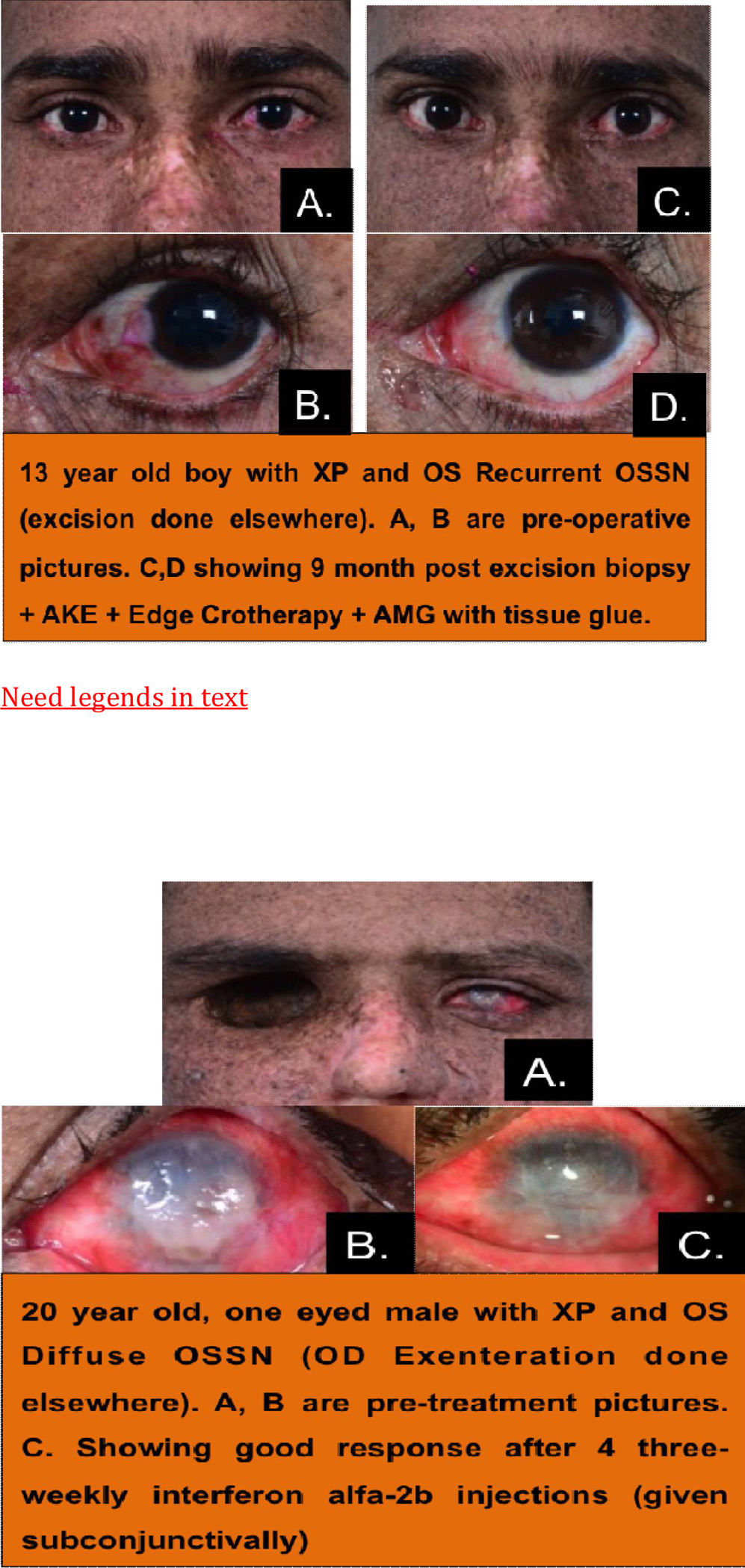
DISCUSSION
OSSN occurs in old age, average age being 56 years.5 However, in XP, OSSN tends to occur at a younger age.1 In our series, no patient was over 40 years of age. 31% cases in our series were bilateral. Gupta et al1 reported 7 bilateral cases of OSSN in XP.
The reported 5-year recurrence rate of OSSN is 21% after excisional surgery.8 There is limited data on recurrence of OSSN in XP. Gupta et al1 reported a recurrence rate of 64.3% in XP patients. In our series, the recurrence rate was 4%, with 5 eyes warranting exenteration.
CONCLUSION
OSSN has earlier age of onset in XP, tends to be bilateral and aggressive.Periodic screening, early diagnosis and prompt management confer good clinical outcome.
REFERENCES
1.Gupta N, Sachdev R, Tandon R. Ocular surface squamous neoplasia in xeroderma pigmentosum: clinical spectrum and outcome. Graefes Arch Clin Exp Ophthalmol 2011;249:1217–21.
2.Reese AB, Wilber IE. The eye manifestations of xeroderma pigmentosum. Am J Ophthalmol. 1943;26:901—11.
3.Kraemer KH, Lee MM, Scotto J. Xeroderma pigmentosum. Cutaneous, ocular, and neurologic abnormalities in 830 published cases. Arch Dermatol. 1987;123:241—50.
4.Goyal JL, Rao VA, Srinivasan R, Agrawal K. Oculocutaneous manifestations in xeroderma pigmentosa. Br J Ophthalmol. 1994;78:295–297.
5.Lee GA, Hirst LW. Ocular surface squamous neoplasia. Surv Ophthalmol. 1995; 39:429–450.
6.Shields JA, Shields CL, De Potter P. Surgical management of conjunctival tumors. The 1994 Lynn B. McMahan Lecture. Arch Ophthalmol. 1997;115:808-15.
7.Ramkumar HL, Brooks BP, Tamura D et al. Ophthalmic manifestations and histopathology of xeroderma pigmentosum: two clinicopathological cases and a review of the literature. Surv Ophthalmol.2011 Jul-Aug;56(4):348-61.
8.Galor A, Karp CL, Oellers P et al. Predictors of ocular surface squamous neoplasia recurrence after excisional surgery. Ophthalmology 2012 Oct; 119(10): 1974-81.
9.Hebra F, Kaposi M. On diseases of the skin includingexanthemata. New Synddenham Soc. 1874;61:252—8
Leave a Comment