

Dr. Shibashis Das, D18765, Dr. Nanda Ashok Kumar
Abstract:
Aim: To assess the accuracy of 2 IOL power formulas (Barrett universal II and Holladay 2) using optical biometry and optimized lens constants.
Methods: Data from patients having uneventful cataract surgery with acrysof IQ SN60WF IOL implantation over 3 months were obtained from the biometry and patient charts. The optimized lens constants were calculated for each formula and was used to determine the predicted refractive outcome for each patient. Patients were grouped according to their axial lengths and sub grouped as short (<22.0 mm), medium (>22.0 mm to <24.5 mm), medium long (>24.5 to <26.0 mm), and long (> 26.0 mm). The residual refractive error was analysed at 6 weeks post op.
Results: The study included 300 patients. The Barrett universal II formula showed the lowest mean absolute prediction error over all the sub group ranges. With Holladay II showing comparable results in medium long and long groups(p<0.05).
Conclusion: in eyes with an AL longer than 24.5 mm, the Barrett universal II formula was a more accurate predictor of actual post-operative refraction than Holladay II formula.
Keywords: IOL, BARRETT, HOLLADAY, ACCURATE FORMULA
Introduction: Cataract in modern day practice is no more a mere visual rehabilitation procedure.It is a premium refractive procedure where people expect the perfect result.
Lens power calculations should really be referred to as lens power estimations due to the fluctuations that we see in the postoperative refractive results.Even the most meticulous ophthalmologists will find that it is difficult to have more than 80% of their patients within 0.5 D of intended target after cataract surgery. This problem becomes more evident when we try to implement our standard IOL formulas over a range of axial lengths. Some IOL formulas fare better with eyes of specific group of axial lengths while having some margin of error with eyes with very long or short axial lengths. Specially in myopic eyes it is difficult to determine the axial length which leads to error in the IOL power calculation. Calculation of intraocular lens power (IOL) in high myopic eyes is challenging, leading to postoperative hyperopia [1-5]. The potential error occurring sources in IOL calculation for high myopic eyes include AL measurement, IOL constants used, and IOL power calculation formula employed. Due to the presence of posterior staphyloma in high myopic eyes, partial coherence interferometry (PCI) may be better than conventional ultrasound for measuring the AL [6,7]. Furthermore, the prediction of refractive accuracy may be improved by adjusting the AL by formulas derived from regression analysis [5]. In terms of the IOL constants used in IOL power calculation formulas, it has been reported that optimized constants greatly improve the predictive refraction outcomes [2,3,8]. Currently, the constants of User Group for Laser Interference Biometry (ULIB) are preferred for high myopic eyes. Relevant studies show that the ULIB constants are more accurate than manufacturer-recommended IOL constants for long eyes [1,3].
- HOLLADAY II: The Holladay 2 formula is conceptually based on the Holladay 1 formula; however, it uses seven parameters for predicting the surgeon factor. These are the AL, corneal power, ACD, lens thickness, age, white-to-white corneal diameter and pre-operative refraction data. How the formula works in detail has not yet been revealed by Jack Holladay.
- Parameters used for ELP prediction. These are AL, corneal power, ACD, lens thickness (optional), age (optional), white to-white corneal diameter (optional), pre-operative refraction data (optional).
- The Holladay 2 formula is recommended for short – long eyes.[12]
- BARRETT UNIVERSAL II: The Barrett Universal 2 formula uses a theoretical model eye in which anterior chamber depth (ACD) is related to axial length (AL) and keratometry. A relationship between the A-constant and a “lens factor” is also used to determine ACD. The important difference between the Barrett formula and other formulas is that the location of the principle plane of refraction of the IOL is retained as a relevant variable in the formula.
- Parameters used for ELP prediction: AL, corneal power, ACD (optional), lens thickness (optional), white-to-white corneal diameter (optional).
- The Barrett formula is recommended for short – long eyes.[12]
Holladay 2 formula was used very commonly with fair accuracy until now when Barrett Universal II has become available for commercial use and its performance showed promise in one previous study [3]. In this study we would try to check the accuracy of both the formulas over a range of axial lengths.
AIMS AND OBJECTIVE:To compare the efficacy of BARRETT UNIVERSAL II vs HOLLADAY II IOL formula in eyes of different axial lengths.
MATERIALS AND METHODS:
- Retrospective comparative studyconducted in the hospital
- Duration of the study: 12 months (1st August 2015 – 31st July 2016)
- Inclusion criteria: All senile uncomplicated nuclear sclerosis cataract cases undergoing surgery were included in the study. All uneventful cataract surgery was included.
- Exclusion criteria: Patients with any history of previous ocular surgery or any other complicated cataract or with lens position other than ‘in the bag’ were excluded. Patients undergoing toric IOL implantation were also excluded from the study.
- Sample size: 200 patients implanted with acrysof IQ calculated with BARRETT UNIVERSAL II
- Optical biometry was done with the help of LENSTAR 900.
- IOL power was calculated with the help of BARRETT UNIVERSAL II.
- Patients were grouped into 4 groups according to their axial lengths. Namely short (<22mm) medium (22-24.5mm) medium long(24.6-26mm) and long(>26mm).
- Alcon acrysof IQ IOL was implanted in the bag in all the patients.
- Patients were implanted with IOL power according to BARRETT UNIVERSAL II.
- Post-operative residual spherical refractive error was determined at 6 weeks follow-up.
- Estimated IOL power with HOLLADAY II was determined by using the data of the patient from the archives using IOL Master 500.
- The IOL powers were retrospectively analysed as to which power is more accurate for specific group of axial lengths.
RESULTS:
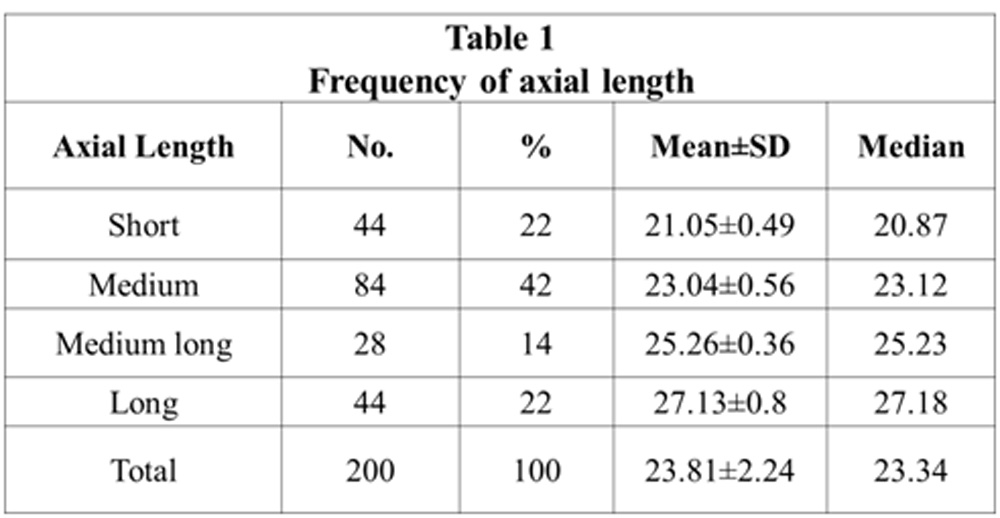
Out of the total 200 observations maximum of 42% belonged to medium category axial length, minimum 14 % belonged to medium long, and 22% each belonged to short and long category axial length.
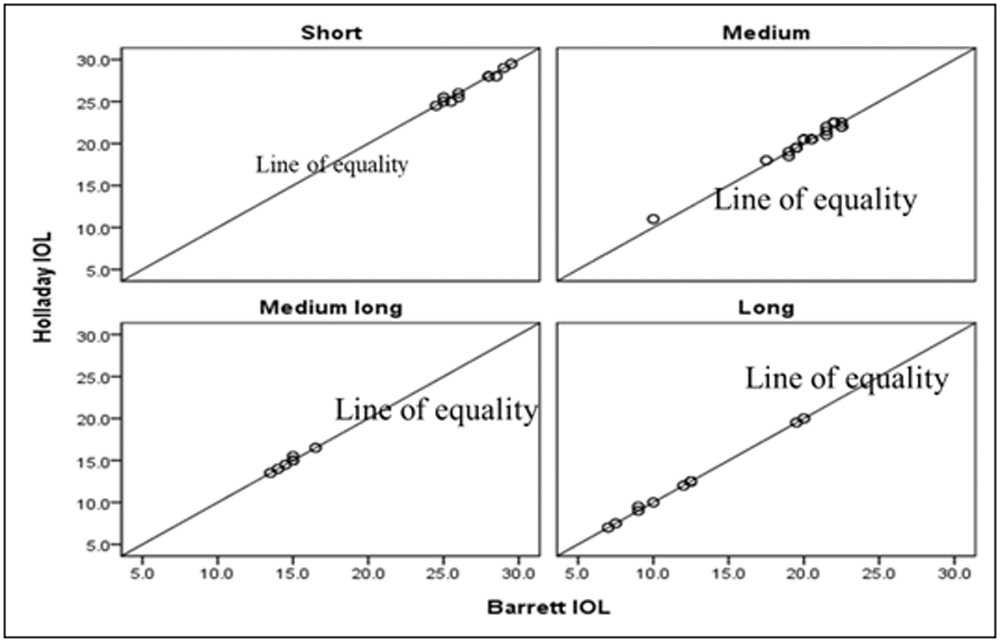
Scattered plot of Barrett IOL vs. Holladay IOL are highly concentrated along line of equality in each category. The R2 Values are extremely high. This points towards high degree of agreement between the two methods of measurement.
Comparison of Barrett and Holladay Measurement of IOL:
- DISCUSSION: Jxkane et al found BARRETT UNIVERSAL II to be a better predictor for axial lengths longer than 22mm when comparing it to other seven 3rd and 4th generation formulas9.
- Yichi Zhang et al found s. Barrett Universal II formula produced the lowest predictive error and the least variable predictive error compared with the SRK/T, Haigis, Holladay, and Hoffer Q formulas. For high myopic eyes, the Barrett Universal II formula may be a more suitable choice10.
- Marilita M. Et al found that Haigis formula provides more accurate results concerning the postoperative target of refraction in eyes with AL less than 22.0 mm compared to other 3rd gen formulas. Hoffer Q could be also used as an alternative11.
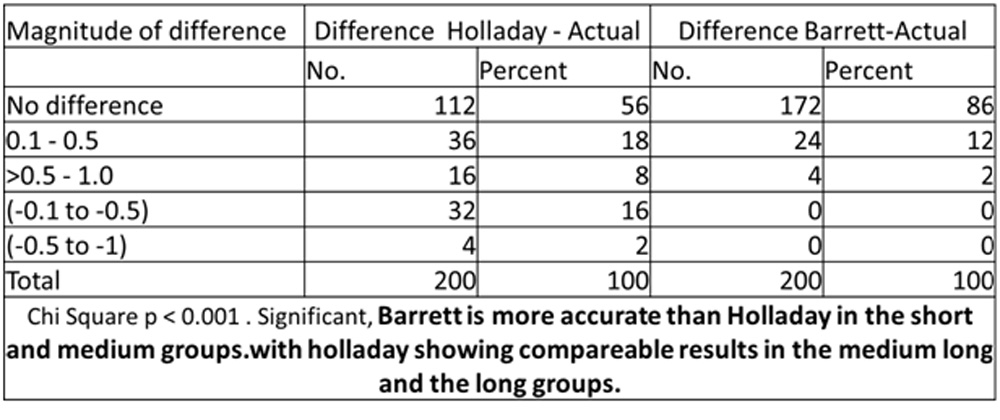
- In our study we found that BARRETT UNIVERSAL II was fairly accurate over the whole range of axial lengths, whereas HOLLADAY II showed comparable result in eyes with medium long and long axial length.
- CONCLUSION:BARRETT UNIVERSAL II was found to have accurate prediction over the whole range of axial lengths. HOLLADAY II predicted accurately in the eyes with axial lengths >24.5mm but was not as accurate with axial lengths lesser than 24.5mm. So, we can conclude that BARRETT UNIVERSAL II is a more reliable prophesier.
- References:
- R. E. MacLaren, M. S. Sagoo, M. Restori, and B. D. S. Allan, “Biometry accuracy using zero- and negative-powered intraocular lenses,” Journal of Cataract and Refractive Surgery, vol. 31, no. 2, pp. 280–290, 2005.
- K. Petermeier, F. Gekeler, A. Messias, M. S. Spitzer, W. Haigis, and P. Szurman, “Intraocular lens power calculation and optimized constants for highly myopic eyes,” Journal of Cataract and Refractive Surgery, vol. 35, no. 9, pp. 1575–1581, 2009.
- A. Abulafia, G. D. Barrett, M. Rotenberg et al., “Intraocular lens power calculation for eyes with an axial length greater than 26.0 mm: comparison of formulas and methods,” Journal of Cataract and Refractive Surgery, vol. 41, no. 3, pp. 548–556, 2015.
- C. S. L. Tsang, G. S. L. Chong, E. P. F. Yiu, and C. K. Ho, “Intraocular lens power calculation formulas in Chinese eyes with high axial myopia,” Journal of Cataract and Refractive Surgery, vol. 29, no. 7, pp. 1358–1364, 2003.
- L. Wang, M. Shirayama, X. J. Ma, T. Kohnen, and D. D. Koch, “Optimizing intraocular lens power calculations in eyes with axial lengths above 25.0 mm,” Journal of Cataract and Refractive Surgery, vol. 37, no. 11, pp. 2018–2027, 2011.
- L. T. Rose and C. N. Moshegov, “Comparison of the Zeiss IOLMaster and applanation A-scan ultrasound: biometry for intraocular lens calculation,” Clinical and Experimental Ophthalmology, vol. 31, no. 2, pp. 121–124, 2003.
- T. Olsen, “Improved accuracy of intraocular lens power calculation with the Zeiss IOLMaster,” ActaOphthalmologicaScandinavica, vol. 85, no. 1, pp. 84–87, 2007.
- E. Terzi, L. Wang, and T. Kohnen, “Accuracy of modern intraocular lens power calculation formulas in refractive lens exchange for high myopia and high hyperopia,” Journal of Cataract and Refractive Surgery, vol. 35, no. 7, pp. 1181–1189, 2009.
- Intraocular lens power formula accuracy: Comparison of 7 formulas. Kane JX et al. J Cataract Refract Surg. 2016 Oct;42(10):14901500. doi: 10.1016/j.jcrs.2016.07.021.
- Accuracy of Intraocular Lens Power Calculation Formulas for Highly Myopic Eyes. YichiZhang et al. Hindawi Publishing Corporation Journal of Ophthalmology Volume 2016, Article ID 1917268, 7 pages https://dx.doi.org/10.1155/2016/1917268.
- Intraocular lens power calculation in eyes with short axial length Marilita M. Moschos et al www.ijo.in DOI: 10.4103/0301-4738.129791.
- IOL Power Calculations Which Formula? https://www.doctor-hill.com/iol-main/formulas.htm.
Leave a Comment