

Dr. Sujit Addya, A18528, Dr. Dipak Bhuyan,
Dr. Bonomita Neogi
INTRODUCTION
Recent Definition by TFOS and DEWS II (AUG ‘2017) :
“Dry eye is a multifactorial disease of the ocular surface characterized by a loss of homeostasis of the tear film, and accompanied by ocular symptoms, in which tear film instability and hyperosmolarity, ocular surface inflammation and damage, and neurosensory abnormalitiesplay etiological roles
Prevalence : 5 – 34 % depending on the criteria for DED applied , the population studied , and geographic location 1-5.
According to DEWS II — 5-50% , higher in Asian population.
. Lee AJ, Lee J, Saw SM, et al. Prevalence and risk factors associated with dry eyes symptoms: a population based study in Indonesia. Br J Ophthalmol 2002;86:1347- 51.
- Lin PY , Tsai SY , Cheng CY , et al . Prevalence of dry eye among an elderly chinese population in Taiwan: the shihpai Eye Study. Ophthalmology 2003;110:1096- 101.
- McCarty CA, Bansal AK , Livingston PM, et al. The epidemiology of dry eye in Melbourne , Australia . Ophthalmology 1998;105:1114- 9.
Risk factors :
General :Ocular :
1) Age : Increases with age . 1) MGD .
2) Gender : Women : Men – 2:1. 2) Blepharitis.
3) Race : Chinese , Hispanics , Asians , 3) Conjunctival disease.
and Pacific Islanders . 4) Ophthalmic Surgery .
4) Poor general health .
5) Medications .
6) Cigarette smoking .
7) Enviromentalconditions .
8) Arthritis.
9) Osteoporosis.
10) Gout.
11) Thyroid disorders.
MATERIALS AND METHODS
This is a prospective study done in 30 patients , suspected of having dry eye based on history and clinical examination inputs.
CLINICAL EXAMINATION:
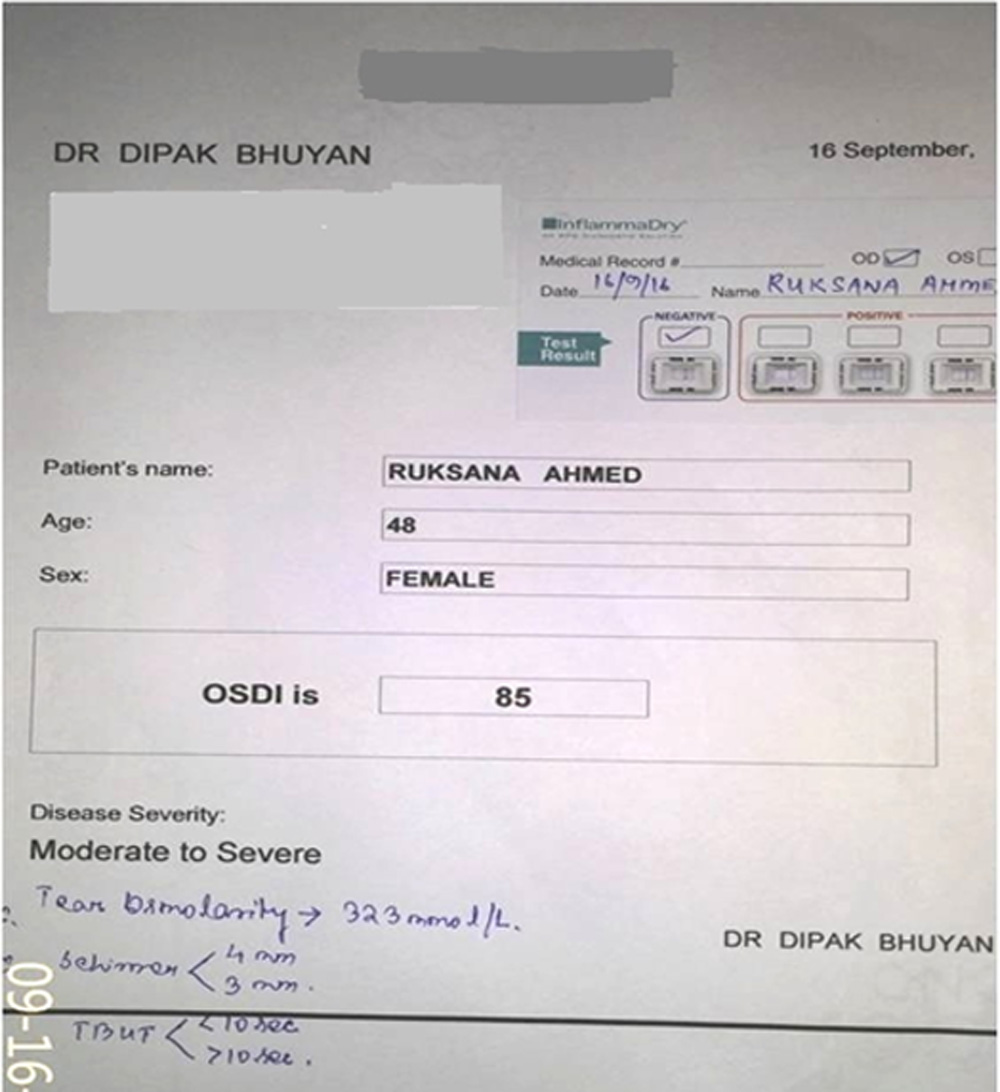
All of them underwent the following – Meticulous History , Clinical examination, Ocular Surface Disease Index (OSDI) score ,Tear film Break up Time (TBUT) , Schirmer’s test OCULAR SURFACE STAINING, Tear Osmolarity level with (Tear Lab) and MMP- 9 estimation with InflammaDry® Package Insert.
Treatment :
- Patient with tear osmolariry> 315m osm/L and
(a) Ocular surface staining and MMP9 negative were put on adequate lubricant.
(b) Ocular Stain and MMP 9 positive were put on lubricants with osmoprotectants, soft steriod , cyclosporine A , tetracycline and Omega 3 fatty acids, etc.
RESULTS
Age and Sex distribution
- Incidence of dry eye increases with age.
- It is more significant in the age range above 40 years.
- Female(56.66%) participants dominated the study.
- Ocular Surface Disease Index(OSDI) score :
- Used to categorize the selected patient’s grade of dry eyes.
- Majority of patients belonged to moderate(63.33%) grade.
Result of the Tear film
Break Up Time (TBUT) :
- We considered< 10 seconds as Positive / Significant and suggestive of dry eye.
| INTERPRETATION | NUMBER OF PATIENT (N= 30) |
| POSITIVE ( TBUT < 10 SEC ) | 17( 56.66 %). |
| TBUT > 10 SEC | 8 ( 26.66%). |
| INDETERMINATE | 5 (16.66%). |
Schirmer’sscore :
- 13(43.33%) patients belong to < 10 mm i.e significant
- Low sensitivity and specificity.
STAINING
- Lissamine green was used for
- 4 (13.33%) patient showed stained ocular surface.
Tear film Osmolarity
- Calculated with Tear Lab machine .
- 315 mOsms/l was taken as the cut off.
- >315 mosms/l was tagged as Hyperosmolar tear in our study .
| Tear film Osmolarity (mOsms/l) | Number of Patients (N =30) |
| > 315 | 17 ( 56.66%) |
| 315- 310 | 10 (33.33%) |
| < 310 | 3 (10%) |
Detection of Inflammatory markers : MMP9.
- With InflammaDry® Package Insert .
- 9 patients exhibited positive response i.e>40 ng/ml .
- Follow Up At 3 Months.
- OSDI score at 3 months follow up.
Improvement is noted
| GRADE OF DRY EYE AS PER OSDI INDEX . | NUMBER OF PATIENTS ( N= 30). |
| MILD | 16(53.33%) |
| MODERATE | 12(40.00%) |
| SEVERE | 2(6.66%) |
Tear lab Osmolarity
At 3 month follow up.
| Tear film Osmolarity (mOsms/l) | Number of patient (N= 30) |
| > 315 | 9(30.00%). |
| 315- 310 | 15(50.00%). |
| <310 | 6(20.00%). |
4 Patient who exhibited positive staining were subjected to staining at 3 months.
At the end of 3 months of treatment , 1(one) patient showed positive
MMP- 9 Level
At 3 months
follow up .
| INTERPRETATION OF RESULT | NUMBER OF PATIENT POSITIVE AT THE BEGINNING OF THE STUDY (N = 9) |
| Positive (> 40 ng/ml) | 4(44.44%). |
| Negative (< 40 ng/ml). | 5(55.55%). |
DISCUSSION
- Osmoprotectants( L- carnitine , Erythritol, Betaine and Glycerol ) differentially suppress gene expression , protein production, and enzymatic activity of inflammatory markers in primary HCECs exposed in hyperosmotic stress1.
- They may have potential effects in protecting ocular surface epithelia from MMP- mediated disorders in dry eye disease1.
1- Ruzhi Deng, Zhitao Su, Xia Hua, Zongduan Zhang, De- Quan Li, Stephen C. Pflugfelder. – Osmoprotectants suppress the production and activity of matrix metalloproteinases induced by hyperosmolarity in primary human corneal epithelial cells . Molecular Vision 2014; 20:1243- 1252https://www.molvis.org/molvis/v20/1243.
- Elevated tear fluid osmolarity has been recognised as a common feature of dry eye for decades1 .
- Hyperosmotic stress stimulates the expression and production of inflammatory markers including MMP- 9 by human corneal epithelial cells(HCEC)2.
- In our study 4 out of 30 cases showed ocular stain positive , but 9 patient of the same group showed inflamma dry eye test positive confirming concentration of MMP9 > 40 ng/ml in their tear film.
- Hence in mild to moderate cases of dry eye patients, ocular surface damage can be identified by Inflama dry eye test before ocular surface staining develops.
1- Farris RL. Contact lenses and the dry eye. IntOphthalmolClin 1994;34:129-36 (PMD: 8169066).
2- Li D- Q, Chen Z, Song XJ, Luo L, Pflugfelder SC. Stimulation of matrix metalloproteinases by hyperosmolarity via a JNK pathway in human corneal epithelial cells. Invest Ophthalmol Vis Sci 2004; 45:4302- 11(PMD: 15557436).
CONCLUSION
Dry Eye Disease(DED) is therefore not simply a lack of tears, but a complex surface disease in which the tear film is unbalanced and no longer provides sufficient nourishment or protection to the ocular surface (reviewed in 2007 Report of the International Dry Eye Workshop (DEWS1).
(1- No authors listed. Report of the International Dry eye Workshop (DEWS) .Ocul Surf 2007;5:1- 204).
Identification of inflammatory markers in tear surface therefore , has paramount importance in dry eye patients , so that effective and definitive intervention can be taken to restore cell volume , stabilise protein function and protect the ocular surface cells from hyperosmolarity stress .
- Last but not the least , it can be inferred from the above discussion that all these newer diagnostics and appropriate intervention are likely to improve the quality of life of the dry eye patients in the coming years.
- However longer follow ups are required to throw more light on the
Leave a Comment