

Dr. Swati Upadhyaya, U10130, Dr. Kavitha S, Dr. Rengaraj Venkatesh
Introduction
- Background and Rationale
Glaucoma is a chronic, progressive optic neuropathy caused by a group of ocular conditions, which lead to damage of the optic nerve with loss of visual function.
According to the World Health Organization, glaucoma is now the leading cause of blindness in the world, second only to cataracts, and is considered the principal cause of irreversible blindness in the world.By 2040 there will be 111.8million persons with glaucoma worldwide, with a disproportionatenumber in less developed countries.
Unfortunately, it is estimated that only half of glaucoma sufferers are diagnosed and treated at present time and the number of undiagnosed glaucoma patients could be much higher in developing or undeveloped countries, reaching more than 90% in rural India. Many of glaucoma patients are diagnosed only in the advanced stages and it is demonstrated that late presentation, when visual field loss threatens central vision, is an important risk factor for blindness.Hence early detection is crucial to initiate treatment in the earliest phases of glaucoma and to avoid its natural progression to blindness.
IOP screening for glaucoma is neither sensitive nor specific as approximately one half of individuals on screening have IOPs below 21 mm Hg. A perimetric evaluation of those with elevated IOPS or suspicious optic nerves would be ideal, but currently there is no easily portable instrument and software capable of doing this. This problem is magnified in underserved populations.
We designed this study to demonstrate the utility and ability of Tablet based supra threshold visual field testing app that is both sensitive and specific for glaucomatous visual field loss. This might help to redefine our ability to intelligently screen for glaucoma and decrease needless blindness.
- Objectives –
- To analyze the correlation between missed points and Mean deviation of HFA
- To assess sensitivity and specificity of the two tablets as compared to standard HFA
Methods
- 4. Design–Prospective, cross-sectional validation study
- 5. Setting –
Location – Glaucoma Services, Aravind Eye Hospital, Pondicherry
Relevant dates – 11th February 2015 to 11th February 2016
Exposure- One point exposure
Follow-up- None
Data collection – All participants had comprehensive ophthalmologic examinations, fulfilled the inclusion criteria.
- 6. Participants –
28 healthy normal control eyes
138 eyes of patients with glaucoma
Cross sectional Study
Inclusion criteria for cases–
- Age above 40 years
- Best corrected Visual Acuity better than 6/18 in both eyes
- Glaucoma of any type and severity with documented reliable visual field defects using HFA 24-2 SITA standard protocol
- No evidence of other ocular or neurologic pathologies
- No systemic disease, other medications or indications that may produce visual field loss
- Willing to give written informed consent
Inclusion criteria for controls–
- Age matched subjects with no Glaucoma
- Relatives of Glaucoma patients with normal optic discs
- Who understood the purpose of the study and were willing to give informed consent
Exclusion criteria–
- Any co-existent ocular pathology other than Glaucoma causing visual field defects
- Unreliable 24-2 HFA results ( including those needing HFA 10-2)
- In the control group, subjects with CD ratio of more than 0.5
- In both arms – Subjects with cataract more than Nuclear sclerosis grade 2 and Posterior subcapsular cataract
DELL TABLET
- MS technologies visual field application incorporated in DELL tablet
- Suprathreshold screening
- Gives the graphic display of patient’s field same as in HFA with false positives , false negatives and time taken per eye
- Works with a hand-held remote (battery operated ) and also by touch screen
- Needs a coordinator to look for fixation losses and to check the working condition of the remote
- Seen points come as black dots, so it is difficult to interpret as it is opposite to HFA and iPad display
iPAD VISUAL FIELDS EASY
- By George Kong software
- VisualFields Easy is designed to use the iPad screen to perform a fast screening test of the visual fields (peripheral vision)
- Suprathreshhold screening
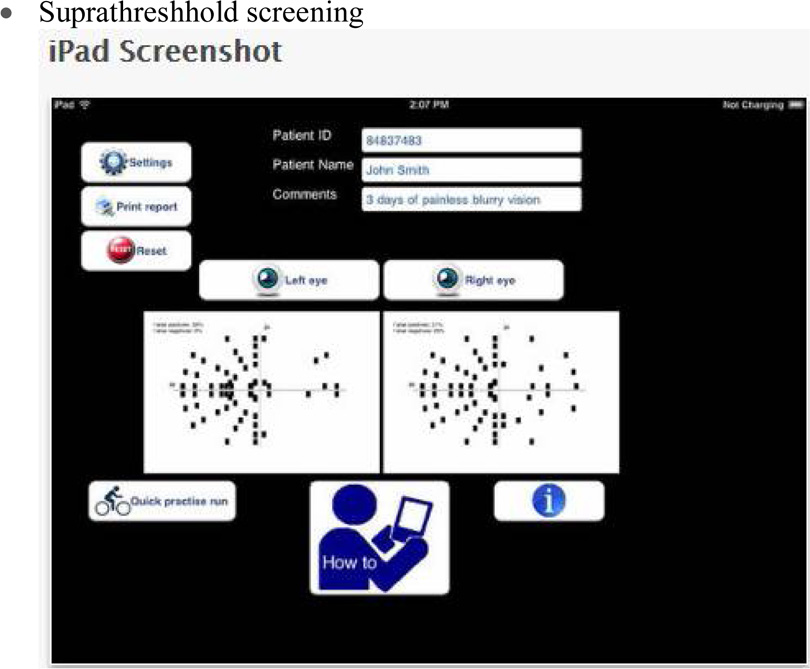
Both procedures have similar test conditions(background luminance of 31.5asb or 10cd/m2, 80cd/m2 or 16bB stimulus luminance. Goldmann size V target,200msec display time, interstimulus interval of 1 second or less, pseudorandom stimulus location presentation,33cm viewing distance,etc.) However, the Visual Fields Easy procedure has 96 target locations, does not recheck missed targets, and requires pressing the display to respond to targets, and the Dell has 60 target locations,rechecks missed targets, and has a USB remote response button.
Methodology
Known case of Glaucoma/controls (n=100 each)
↓
HFA field(Reliable)
↓
DELL field and IPAD visual field easy
↓
Preliminary examination by Glaucoma Consultant
The average test time for the Visual Fields Easy was 3.3 minutes and the average test time for the Dell was 1.9 minutes.
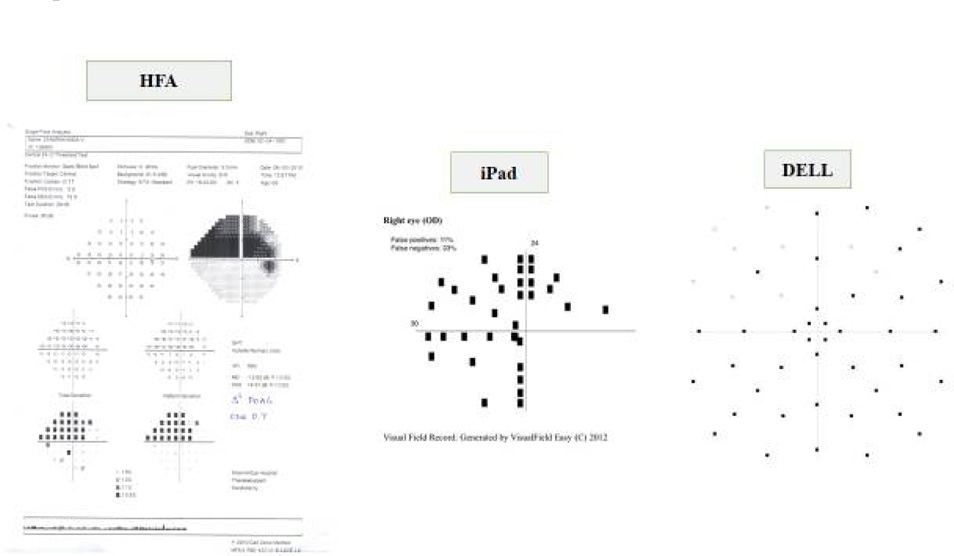
Example 1
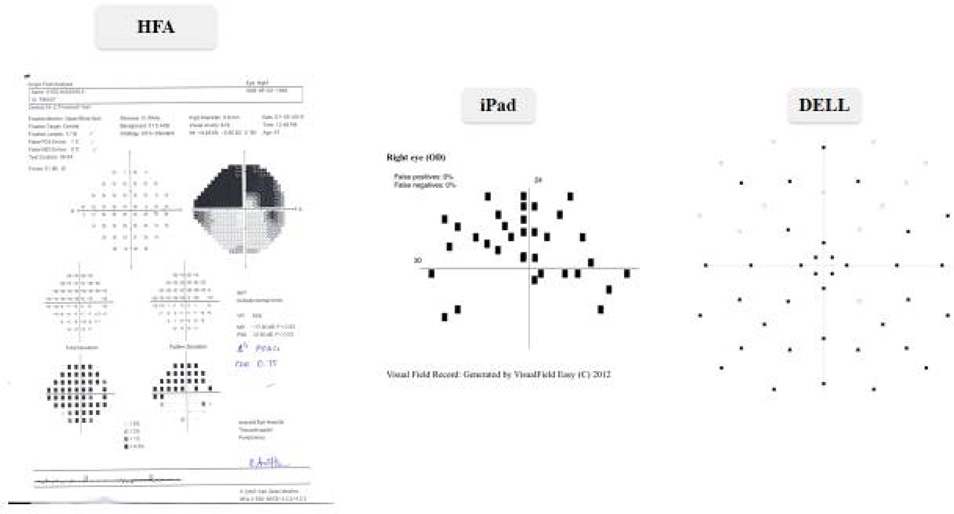
Example 2
Statistical Analysis
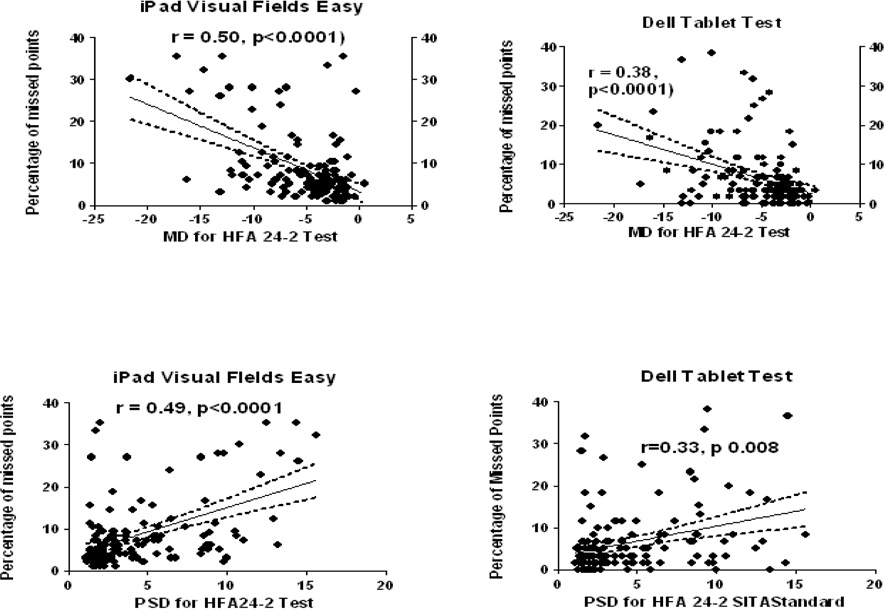
Pearson Product moment correlations, with the percentage of test points that were missed compared to the visual field indices (MD, PSD, Total Deviation and Pattern Deviation)
For PSD, we compared the percentage of points that were missed to the PSD score.
Results
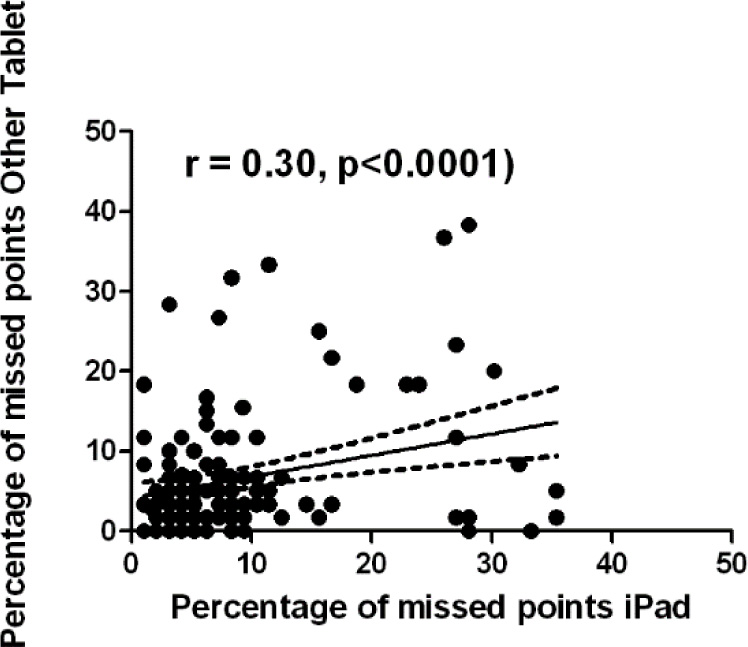
The Visual Fields Easy procedure had a percentage of missed test points that was significantly correlated with HFA Mean Deviation (MD,r = -0.50, p <0.0001) and the Dell test also had a percentage of missed test points that correlated with HFA Mean Deviation (MD, r = -0.38,p <0.0001). Missed points for Visual Fields Easy also correlated with HFA Pattern Standard Deviation (PSD, r = 0.49, p<0.0001), and missed points for the Dell also correlated with HFA Pattern Standard Deviation (PSD, r = 0.33, p<0.008)
Sensitivity and Specificity of the two tablet fields as compared to HFA
The sensitivity and specificity for the iPad Visual Fields Easy app in comparison to the HFA is presented in the Receiver Operating Characteristic (ROC) curves given below.
Conclusions
Glaucoma is an optic neuropathy and is usually confirmed by visual field changes. It is a leading cause of blindness in all racial groups. IOP screening for glaucoma is neither sensitive nor specific as approximately one half of individuals on screening have IOPs below 21 mm Hg. A perimetric evaluation of those with elevated IOPs or suspicious optic nerves would be ideal. The new tablet based tests are portable, inexpensive, relatively quick, and relatively sensitive and specific.
Both tablet procedures demonstrated an ability to detect glaucomatous visual field loss comparable with the gold standard Humphrey fields. The Visual Field Easy test was slightly better than the Dell procedure, but it required about 40% additional time.
Additional efforts needed to improve performance by reducing testing time are currently underway.
We feel that this may usher in a new era in which we may be able to intelligently screen for glaucoma in those who might go blind in their lifetime.
Leave a Comment